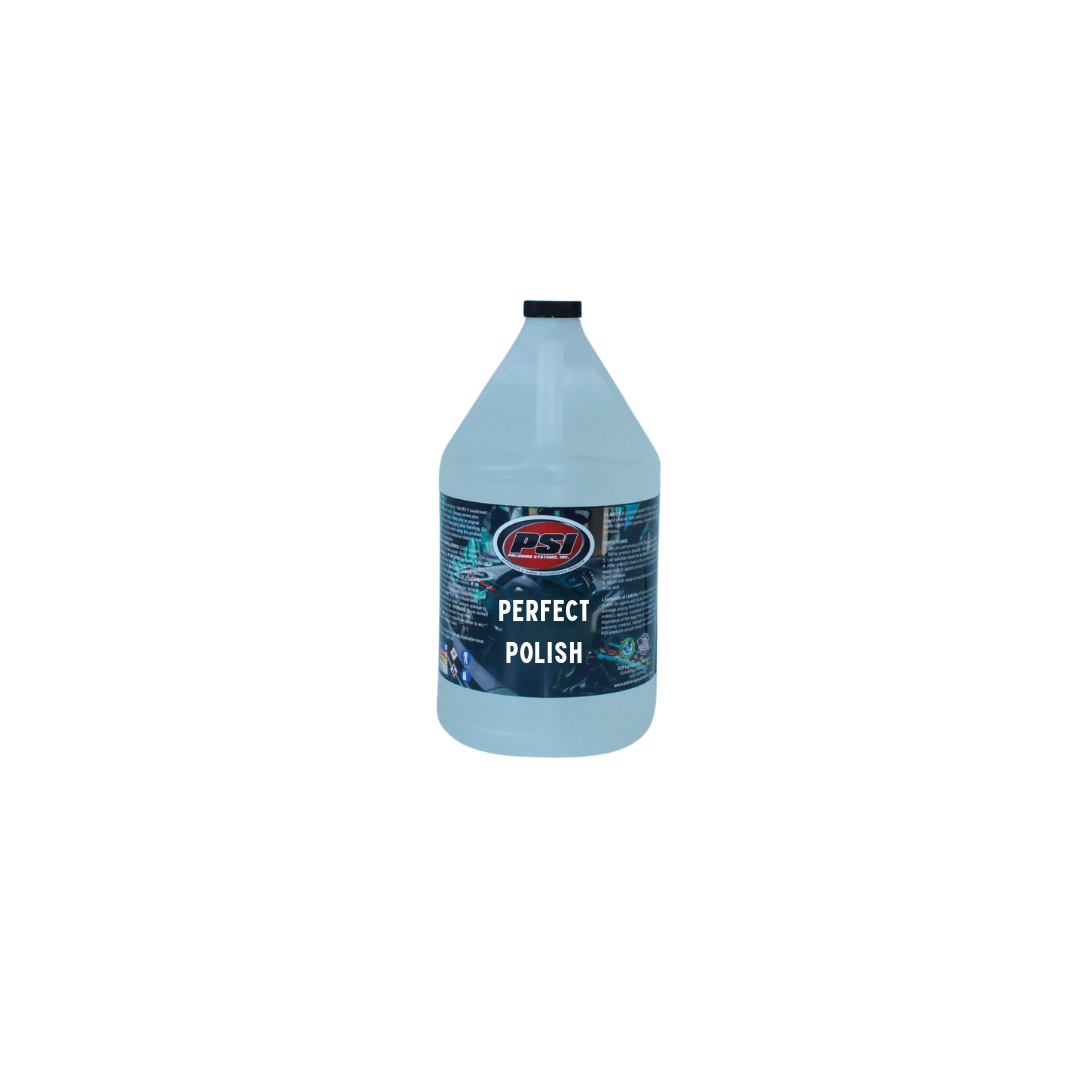

If paint correction is a regular part of your weekly workflow — new-car prep before ceramic coating, seasonal swirl removal for maintenance clients, or gel coat restoration on boats — buying polish by the ounce does not make business sense. At production volume, the 1-gallon size is the right format: enough product for 25–40 full-vehicle corrections without reordering, priced per ounce well below retail bottles, and in the same professional-grade formula as the smaller sizes.
Perfect Polish 1 Gallon is the workhorse polishing-step product for active detail shops. The diminishing-abrasive formula cuts through light-to-medium paint defects, transitions to a finishing gloss on the same pad, and wipes off cleanly — reducing total production time per vehicle and keeping shop workflows moving.
What Perfect Polish Is
Perfect Polish is a medium-duty finishing polish for machine application on automotive paint and marine gel coat. It uses a diminishing-abrasive system: abrasive particles cut through surface defects and break down progressively under polisher pressure, finishing glossy without requiring a separate jeweling pass. The 1-gallon format is identical in chemistry to the 16 oz and 32 oz versions — in the volume that production detailing actually needs.
Key Features and Why They Matter
- Production-volume 1-gallon size — covers 25–40 full-vehicle correction jobs depending on panel condition. Dramatically reduces per-job product cost compared to retail bottles.
- Diminishing-abrasive technology — cuts and finishes in one pad, one pass. Cuts total labor time per correction job and minimizes pad changes mid-vehicle.
- DA and rotary compatible — works across machine types, adjusts in aggressiveness by machine speed and pad choice.
- Paint and gel coat compatible — one product covers both automotive and marine correction work a full-service shop encounters.
- Low-residue formula — wipes off with standard microfiber pressure. Reduces pad saturation rate in production use.
What Perfect Polish Is NOT For
Perfect Polish is a medium polish, not a cutting compound. Deep scratches, 600-grit sanding marks, severe oxidation, and clear coat failure require a heavier cutting compound first. See the compounds and polishes category for heavier cutting options. Perfect Polish also provides no protective layer — always follow with sealant, wax, or ceramic coating.
Who Uses This
The 1-gallon size is for production-shop use: detail shops doing 5–20 correction jobs per week, fleet reconditioning operations, dealership reconditioning departments, and high-volume mobile detailers running multiple technicians. It also makes sense for enthusiast garages treating 10–20 vehicles per year who want to stock one professional-volume container.
How to Use
- Surface prep: Wash, decontaminate, clay if needed, and dry the vehicle before polishing. Work on cool panels out of direct sun.
- Decant into a working bottle: Pour from the gallon jug into a smaller dispensing bottle for controlled application at the polisher.
- Prime the pad: Apply 4–5 pea-sized drops to a foam polishing pad. Spread at low speed before working at correction speed.
- Work panel by panel: Polish in 2×2 ft sections, overlapping passes by 50%. Wipe and inspect after each section before moving on.
- Machine settings: DA polisher speed 3–5 for maintained paint; increase for more correction on oxidized or neglected surfaces.
- Follow with protection: Apply sealant, wax, or ceramic coating after correction to seal in results.
Why Buy This vs. Smaller Retail Sizes
When polishing multiple vehicles per week, the price difference between a retail 16 oz bottle and a professional 1-gallon container is substantial. The 1-gallon size delivers significantly lower per-ounce cost while maintaining the same formula. Decanting from a gallon into a working bottle once per day is also faster than managing multiple small bottles on a shop bench.
Frequently Asked Questions
How many vehicles does 1 gallon of Perfect Polish cover?
At standard application rates — roughly 3–5 ml per 2×2 ft section — one gallon covers approximately 25–40 full vehicle corrections. High-defect vehicles requiring more passes use more product; lightly swirled maintained vehicles use less.
What is the shelf life of an opened gallon?
Stored properly with the lid tightly closed and kept away from temperature extremes, Perfect Polish maintains performance for 2–3 years after opening. If the product separates, mix thoroughly before use.
Can I dilute Perfect Polish to make it stretch further?
No. Perfect Polish is a formulated polish, not a concentrate. Adding water will disrupt the abrasive suspension and the chemical balance of the formula. Use at full strength as directed for consistent results.
Does this work on new car paint that has rail dust and dealer prep swirls?
Yes — new car prep is one of the most common use cases. New vehicles frequently arrive with transport scratches, rail dust, and washing swirls from dealer prep. Perfect Polish handles those defects efficiently before a ceramic coating or paint protection film application.
What pads work best in a production-shop environment?
A medium-density foam polishing pad is the standard pairing for full-vehicle correction. For softer paint or final passes on dark colors, switch to a soft finishing pad. In a shop environment, wash pads after every 2–3 vehicles to maintain consistent cut rate and avoid product buildup that reduces effectiveness.