
For most vehicles that come through a detail bay — daily drivers, fleet vehicles, customer cars that have accumulated a year or two of car wash swirling — the job does not require heavy compounding or wool pads. The paint has moderate swirling, maybe some water spots or light oxidation, and it needs correcting efficiently without making a multi-hour production out of it. A medium-cut foam pad with the right polish does the work in a single stage and leaves a surface that needs minimal finishing.
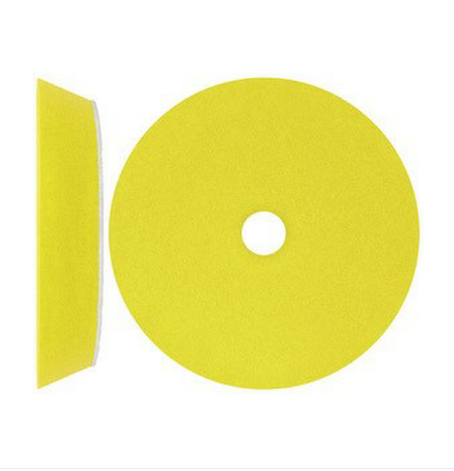
The 8.25″ x 1.5″ Yellow Foam Grip Pad with Convoluted Face and Recessed Back (SKU BS830WG) is the medium-density option in the 8.25-inch foam pad lineup — the pad that earns its place in daily detailing work. Yellow foam has enough cut for light to moderate defect removal, enough cushion to manage heat on sensitive clear coat, and leaves a surface refined enough to move directly to a finishing step without needing a separate intermediate polishing stage on most paint systems.
What This Product Is
This is an 8.25-inch diameter, 1.5-inch deep yellow foam polishing pad with a convoluted face and recessed backing. Yellow foam is the standard medium-cut density — used for one-step paint enhancement, moderate swirl removal, light oxidation correction, and compounding on softer paint systems. The convoluted face distributes polish more uniformly than a flat face and reduces residue buildup during use.
Key Features and Why They Matter
- Medium-cut yellow foam — the most versatile density for everyday detailing. Enough cut for light to moderate defect correction, controlled enough for use on sensitive clear coat without excessive heat generation.
- Convoluted face design — increases product distribution across the pad surface, reduces midpoint residue buildup, and maintains more uniform abrasive contact from the start to the end of each panel section.
- Recessed back — reduces pad weight and promotes air circulation through the backing to manage heat buildup during extended polishing sessions on large surfaces.
- 8.25-inch diameter — covers hoods, roofs, trunk lids, and large door panels efficiently, which is the practical reason to use a larger pad on the straightforward panel work that makes up most of a detail day.
- Grip backing — secure hook-and-loop attachment to 8-inch backing plates. Compatible with rotary and DA polishers.
What This Is NOT For
This is a medium-cut polishing pad, not a heavy correction or compounding pad. For deep sanding marks, severe oxidation, or heavily scratched paint, this foam density will not generate sufficient cut to be productive — use a blue cutting foam or wool pad for those situations. It is also not a finishing pad — after using yellow foam for correction, a soft black foam finishing pad with finishing polish will be needed to achieve maximum gloss on darker colors and high-gloss paint. It is not for wax or sealant application.
Who Uses This
Mobile detailers use this as their daily working pad — the pad they reach for on the majority of vehicles that need one-step correction and polish enhancement. Detail shops processing steady volume of customer vehicles with normal surface defects use yellow foam as the standard correction pad because it handles most jobs efficiently without requiring a multi-stage compound-plus-polish sequence. Fleet maintenance operators polishing company vehicle pools use large-format foam pads for coverage speed on uniform, predictable paint conditions.
How to Use
- Mount: Attach to an 8-inch hook-and-loop backing plate on your DA or rotary polisher.
- Apply product: Place 4 pea-sized drops of medium-cut polish or one-step compound/polish on the pad face. Spread at low speed before starting the correction pass.
- Set speed: DA polisher: setting 3–5. Rotary: 1,000–1,400 RPM. Adjust based on paint softness and target correction level.
- Work in sections: Cover 2–3 square feet per section with overlapping passes. Light to moderate pressure. Work the product until it works clear.
- Inspect: Check under a panel light for remaining defects. Light swirls and oxidation should be fully removed or significantly reduced in one pass.
- Finish: Follow with a soft black foam finishing pad if maximum gloss is required, or move directly to LSP application if the yellow pad result meets the target standard.
Why Buy This vs. Using One Pad for Everything
Many entry-level detailers try to use a single pad density for every stage — correction, polishing, and finishing. The result is compromise at every step: too little cut for correction, too much cut in the finishing stage leaving micro-marring. Using the correct foam density for each stage dramatically improves the final result and reduces total polishing time per vehicle. Pair this yellow medium-cut pad with the 8.25″ black foam finishing pad for a two-stage system that covers most daily detailing work. See the full exterior polishing pad range for all available sizes and densities.
Frequently Asked Questions
Can I do a complete one-step correction and polishing job with just this yellow foam pad?
On most daily-driver vehicles with moderate swirling and light oxidation, yes — the yellow medium-cut foam pad with an appropriate one-step compound/polish can deliver a complete correction and refinement result in a single pass. For very dark paint or show-quality finishing work, a second pass with a soft finishing pad will improve the final gloss level. For heavily defected paint, a heavier cutting pad stage before the yellow foam step will be more efficient.
Will this pad work on single-stage paint?
Use caution with yellow foam on single-stage paint. Single-stage paint has no separate clear coat layer, so any cutting action removes actual color pigment. Use very conservative machine speeds and light pressure on single-stage paint. Test on an inconspicuous area first, and consider using a softer finishing pad instead if the correction requirement is light.
How often should I clean the pad during a session?
Clean the pad after every 1–2 panel sections to remove accumulated polish residue from the convoluted face channels. A pad conditioning brush applied briefly to the spinning pad at low speed clears the face effectively without stopping your workflow. Do not allow polish residue to build up to the point where the convoluted texture fills in — a loaded pad loses cutting efficiency significantly.
What backing plate should I use with an 8.25-inch pad?
An 8-inch hook-and-loop backing plate is the standard match for an 8.25-inch foam pad. The slight size difference — quarter inch of pad extending past the plate edge — allows the pad perimeter to flex over body lines and contours. Using a plate that is too small or too large will cause uneven pad loading and premature wear.
Is the recessed back purely cosmetic or does it serve a purpose?
The recessed back is functional. Removing material from the pad backing reduces total pad weight, which reduces the dynamic load on the backing plate spindle during operation — especially on DA machines where the orbiting motion amplifies weight effects. The recesses also create channels for air circulation that help manage heat buildup in the foam core during extended polishing sessions on large panel surfaces.