
The difference between a paint job that looks good and one that looks wet and three-dimensional is typically decided in the final polishing pass. You can do excellent compounding and polishing work but leave micro-marring, holograms from the rotary, or a haze from medium compound residue — and the final surface suffers for it. The finishing stage is not about removing defects; it is about refining the surface to the point where the clear coat’s depth and clarity are fully visible.
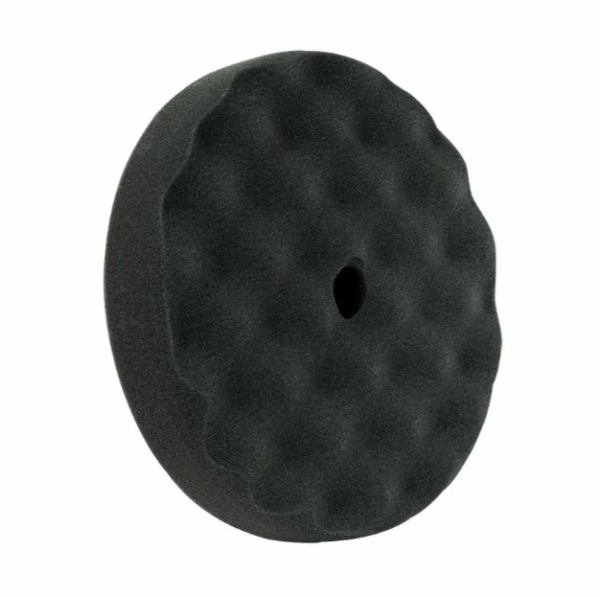
The 8.25″ x 1.5″ Black Foam Grip Pad with Convoluted Face and Recessed Back (SKU BS820WG) is the soft-density finishing pad built for that final stage. The black foam color indicates this is a minimal-cut pad — it is not designed to remove defects, it is designed to refine, smooth, and gloss the clear coat after the heavier correction work is complete. The convoluted face and recessed back are functional design elements that influence how the pad distributes product and manages heat during the finishing pass.
What This Product Is
This is an 8.25-inch diameter, 1.5-inch deep black foam polishing pad with a convoluted (waffle-texture) face and a recessed backing pattern. Black in the professional foam color system indicates the softest, lowest-cut density used in paint finishing work. The convoluted face provides increased surface area contact compared to a flat foam face, which improves product distribution and creates a more uniform finish across the panel.
Key Features and Why They Matter
- Soft black foam density — removes micro-marring and rotary holograms without introducing new defects. Provides the clearcoat refinement needed to achieve the wet-gloss result in the final polishing stage.
- Convoluted (waffle) face — the textured face pattern increases effective contact surface area compared to a flat foam face. More contact means more uniform product distribution and a more consistent finish across the full panel. The raised sections also handle product spread efficiently.
- Recessed back design — reduces weight and improves airflow through the pad backing, which manages heat buildup during extended finishing sessions. Cooler foam maintains its soft-density characteristics longer.
- 8.25-inch working diameter — covers large panel sections in fewer passes, which is especially valuable during the finishing stage where you want consistent, even coverage across hoods, roofs, and large door panels.
- Grip (hook-and-loop) backing — compatible with standard 8-inch hook-and-loop backing plates used on rotary and DA polishers.
What This Is NOT For
This black foam finishing pad is not a cutting pad. Do not use it for removing sanding marks, significant swirling, heavy oxidation, or any defect that requires real cutting action — it will not have the cut rate to remove them and will waste your time. It is the final step in a multi-stage correction sequence, not a standalone correction tool. Do not pair it with heavy compounds — pair it with finishing polishes, glazes, or light sealants. Using a finishing pad with a heavy compound is a waste of both products.
Who Uses This
Detail shops running multi-step paint correction services use a soft finishing pad as the last machine pass before inspection and LSP application. Mobile detailers doing single-machine correction use the finishing pad to clean up any haze left by their medium-cut stage. Show prep detailers use soft finishing foam for jeweling clear coat — the process of extracting maximum depth and gloss from the paint surface. Body shop reconditioning technicians use it to refine fresh clear coat after wet sanding before final inspection.
How to Use
- Mount: Attach to an 8-inch hook-and-loop backing plate on your DA or rotary polisher.
- Apply finishing polish: Place 3-4 pea-sized drops of finishing polish or glaze on the pad face. Work at low speed to spread the product before beginning the finishing pass.
- Set speed: On a DA polisher, setting 3–5 depending on machine. On a rotary, 900–1,200 RPM for finishing work — rotary speed should be conservative to avoid swirl introduction at this stage.
- Work in sections: Cover 2–3 square feet per section with overlapping passes until the polish works clear and transparent.
- Inspect: Inspect under a focused panel light for remaining micro-marring or haze. The finishing pad stage should eliminate any remaining defects from the prior polishing stage.
- Apply LSP: Follow the finishing pad stage with your choice of wax, sealant, or ceramic coating.
Why Buy This vs. Using Your Polishing Pad for Finishing
Running a medium-cut polishing foam pad for the finishing stage introduces unnecessary cut that creates micro-marring at the cellular level — visible as a slight haze under direct light. A dedicated soft finishing pad at the appropriate foam density produces a consistently cleaner final surface. Pair this pad with the 8.25″ yellow cutting foam pad for a two-stage correction and finishing system on the same backing plate. See the full exterior polishing pad selection at Polishing Systems Inc for a complete multi-stage system.
Frequently Asked Questions
What is the difference between black, white, and yellow foam pads?
In the standard foam pad color system, yellow indicates medium-cut polishing foam, white indicates a very light finishing foam, and black indicates the softest finishing and glazing foam. Black foam pads are the least aggressive — they are used only for the final refinement stage, not for defect removal. White pads are similarly soft and typically used for final finishing polish application. Yellow and similar mid-density foams are the workhorses for one-step correction and polishing.
What is the convoluted face design for?
The convoluted or waffle-pattern face increases the effective surface area of the pad in contact with the paint, which distributes finishing polish more uniformly across the panel. The raised and recessed pattern also allows product to distribute through the face geometry during the pass, reducing the tendency for excess product to accumulate at the pad edge and fling off during operation.
Can I use this pad to apply wax or ceramic coating?
A soft foam pad can be used to apply paste wax or liquid wax by machine at very low speed. For ceramic coating application, follow the coating manufacturer’s specific instructions — most ceramic coatings specify hand application with a dedicated applicator block and suede cloth, not machine application. For wax application, a dedicated foam applicator pad is preferable to a buffing pad to avoid cross-contamination with residual polish chemistry.
How do I tell if a panel needs a second finishing pass?
Inspect under a focused, adjustable panel light held at a low angle to the surface. Micro-marring and holograms appear as fine cross-hatch patterns or a light haze in this inspection light. If present after the first finishing pass, a second light pass with fresh finishing polish will typically resolve them. A truly clean finishing result shows as uniform depth and gloss with no patterned haze visible at any light angle.
What backing plate size should I use with an 8.25-inch pad?
Pair an 8.25-inch finishing foam pad with an 8-inch hook-and-loop backing plate. The slight pad-to-plate size difference — where the pad diameter exceeds the backing plate diameter by about a quarter inch — allows the pad edge to flex over body lines and contoured surfaces without the hard edge of the backing plate creating pressure marks on the paint.