When the correction job is past what a finishing or medium polish pad can handle — paint with significant swirl accumulation, oxidized clear coat, or scratches that go deeper than surface haze — you need a pad with real cutting ability. The challenge is choosing the right density: aggressive enough to remove the defect in a reasonable time, but not so aggressive that you introduce a new set of problems that require additional correction steps to fix.
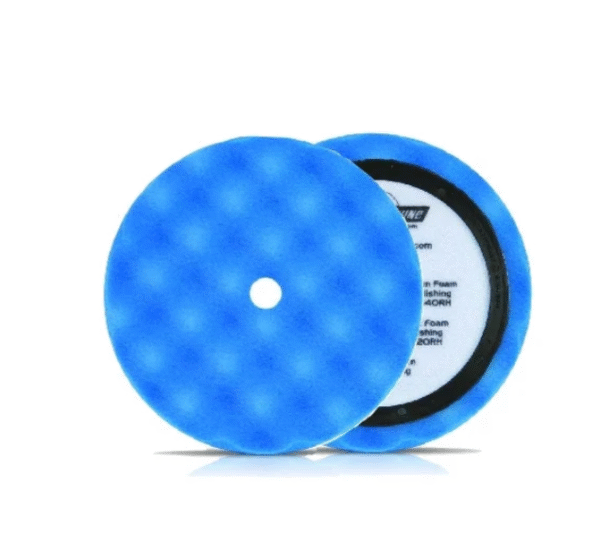
The 8.25″ x 1.5″ Blue Foam Grip Pad with Convoluted Face and Recessed Back (SKU BS850WG) is the medium-cut option in the 8.25-inch foam pad lineup. Blue foam density sits between the more aggressive cutting pads and the softer finishing foam — appropriate for correction jobs that need real cut but where the paint condition does not require the maximum aggressiveness of a heavy compound and cutting pad. The convoluted face and recessed back are functional design elements that help the pad manage heat and residue during extended correction sessions.
What This Product Is
This is an 8.25-inch diameter, 1.5-inch deep blue foam polishing pad with a convoluted face and recessed backing. Blue in the foam pad color system designates a medium to medium-aggressive cut density — more cutting power than yellow or white finishing foams, used for compound application, swirl removal, and light to moderate oxidation correction. The convoluted face surface increases product distribution efficiency across the pad face.
Key Features and Why They Matter
- Medium-cut blue foam density — provides sufficient cut for moderate swirl removal, light oxidation correction, and compounding applications where maximum aggressiveness is not needed. Balances correction speed with manageable heat generation.
- Convoluted face — the textured waffle-pattern surface distributes compound or polish across the pad face more uniformly than a flat foam surface, reducing uneven wear and maintaining consistent abrasive contact throughout the correction pass.
- Recessed back — removes weight from the pad and promotes airflow through the backing, helping manage temperature during extended use. Lower heat means the foam maintains its cut characteristics longer through a correction session.
- 8.25-inch working diameter — maximizes coverage on large panel surfaces, reducing the number of passes needed and keeping production time per vehicle manageable.
- Grip (hook-and-loop) backing — compatible with standard 8-inch hook-and-loop backing plates on both rotary and DA polishers.
What This Is NOT For
This is a cutting/compounding pad — it is not a finishing pad. After using this pad for correction, you will need to follow up with a soft finishing pad and finishing polish to remove the micro-marring and haze this pad density will introduce. Do not use it for applying wax, sealant, or glaze — those require softer applicator foam. For very heavy defect correction requiring maximum cut, consider stepping up to a wool compounding pad for the initial correction pass before transitioning to foam.
Who Uses This
Auto detailers doing multi-step paint correction use a medium-cut foam pad as the working pad for the compound stage when full wool aggression is not needed. Detail shops correcting a variety of daily-driver vehicles with moderate swirl and oxidation use the blue foam with a medium compound to produce a correction result that leaves minimal follow-up work for the polishing stage. Reconditioning operations running DA polishers at high volume use medium-cut foam pads as their primary compounding pad for the majority of vehicles they process.
How to Use
- Mount: Attach to an 8-inch hook-and-loop backing plate on your rotary or DA polisher.
- Prime the pad: Apply 4 pea-sized drops of medium to heavy-cut compound to the pad face. Spread at low speed before beginning correction passes.
- Set speed: DA polisher: setting 4–5. Rotary: 1,200–1,500 RPM for correction work. Adjust based on paint hardness and defect depth.
- Work in sections: Address 2–2.5 square feet at a time. Moderate pressure on DA, firm controlled pressure on rotary. Work until the compound works clear.
- Inspect and repeat: Check defect removal under a panel light. Repeat passes on persistent defects before moving to the polishing stage.
- Follow up: After correction, switch to the 8.25″ black foam finishing pad with finishing polish to refine the surface.
Why Buy This vs. a Non-Engineered Foam Pad
Flat-face foam pads without convoluted geometry accumulate compound residue between the pad and paint as a film layer that reduces abrasive contact over the course of a panel. The convoluted face design manages this by channeling product distribution through the face pattern, maintaining more consistent abrasive contact from the first pass to the last. For the full foam pad lineup in multiple densities and sizes, browse the exterior polishing pad selection at Polishing Systems Inc.
Frequently Asked Questions
How does blue foam compare to yellow foam in cut aggressiveness?
In the standard foam pad color system, blue typically indicates more aggressive cut than yellow. Blue foam pads are generally the compounding stage pad, while yellow indicates medium polishing density. However, specific cut rates depend on the manufacturer — always confirm the intended use based on product description rather than color alone, since color coding is not fully standardized across all pad brands.
What compound works best with this blue foam pad?
A medium-cut or heavy-cut compound pairs well with blue medium-density foam. For moderate swirling and oxidation, a medium compound with the blue pad delivers efficient correction with manageable follow-up. For heavier defects, use a heavy-cut compound and consider whether a wool pad stage before the foam stage would be more productive.
Can I use this pad on fresh clear coat after wet sanding?
Yes — the blue foam compounding pad is a common choice for the first machine pass after wet sanding fresh clear coat. The foam distributes compound evenly across the sanded surface and removes the uniform sanding scratches efficiently. Follow with a softer finishing pad and finishing polish to reach the final clarity needed before the clear coat cures fully.
How do I know when the pad needs cleaning during a session?
The pad needs cleaning when compound residue visibly builds up on the pad face, reducing the texture of the convoluted pattern, or when you notice the pad starting to glaze — the surface becomes smooth and shiny rather than textured. A pad brush applied lightly to the spinning pad at low speed clears the residue without stopping the machine.
What is the difference between the 8.25″ and 7.5″ versions of these pads?
The 8.25-inch pad covers more area per pass and works with an 8-inch backing plate, making it more efficient on large flat panels. The 7.5-inch pad, such as the 7.5″ yellow foam hex face pad, is more appropriate for smaller panels, tight contours, and two-door vehicles where the larger pad size becomes unwieldy around body lines.