
One of the most common situations in auto detailing is a vehicle that needs more than a finishing polish but less than a full heavy-compound correction — paint that has moderate swirling, light oxidation, or water etching that a medium-cut compound and the right foam pad can resolve in a single pass. Getting that combination right means the vehicle comes off the machine clean, with gloss, without spending extra time on a polish stage that would have been unnecessary if the first pad had done the work.
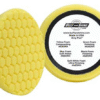
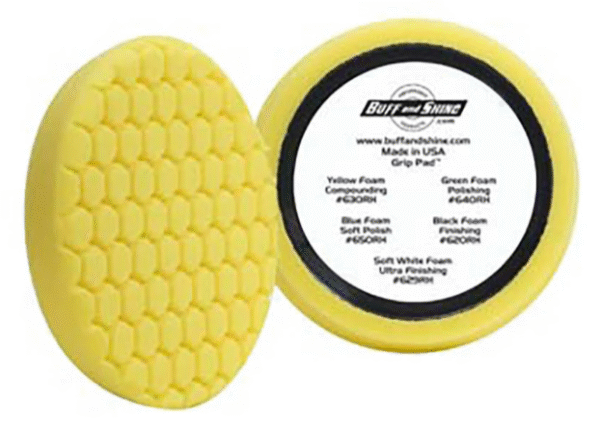
The 7.5″ Yellow Foam Grip Pad with Hex Face and Center Ring (SKU BS630RH) is engineered for that middle zone of paint correction — where you need real cut without the aggressiveness of a wool pad or a heavy cutting foam, and enough cushion in the foam density to leave a finish that needs minimal refining. The hexagonal face and center ring design are functional additions, not aesthetic ones: they manage heat and residue during the pass, which keeps the pad working effectively across a full panel.
What This Product Is
This is a 7.5-inch diameter, 1.35-inch deep yellow foam polishing pad with a hex-patterned face and a central ring. Yellow foam in the professional pad color coding system typically indicates medium to light-cut density — less aggressive than orange or blue, more cutting ability than white or black finishing foam. The hex face pattern and center ring are engineered features that manage compound flow and thermal buildup during use.
Key Features and Why They Matter
- Hexagonal face pattern — channels compound residue toward the edges of the pad instead of allowing it to build up as a thick layer between the pad and paint. Less residue buildup means more consistent abrasive action and fewer compound-splatter incidents at speed.
- Center ring design — allows air circulation through the center of the pad during operation, reducing heat accumulation in the foam core. Cooler foam maintains its density characteristics longer through a correction session, preventing pad glazing.
- Medium-density yellow foam — provides enough cut to address light swirls, water spots, and light oxidation in a single pass when used with appropriate polish, while leaving a surface that requires minimal follow-up work.
- 7.5-inch working diameter — covers large panel sections efficiently on both rotary and DA polishers, reducing correction time on hoods, roofs, and trunk lids.
- Grip (hook-and-loop) backing — compatible with standard 7-inch and 7.5-inch hook-and-loop backing plates.
What This Is NOT For
This pad is a medium-cut polishing pad — it is not appropriate for deep sanding mark removal or heavy oxidation that requires a wool compounding pad or heavy-cut foam. At the other end of the scale, it is not a finishing pad and will leave minor micro-marring that requires a soft foam finishing pad and finishing polish to fully resolve on dark-colored or highly reflective paint. It is not designed for use as a wax or sealant applicator — foam applicator pads are the correct tool for that.
Who Uses This
Mobile detailers running one-step paint enhancement services use a yellow medium-cut foam pad as their standard working pad — it provides enough correction for the majority of daily-driver vehicles that need swirl reduction but are not paint-correction candidates. Detail shops doing single-stage correction on lightly to moderately defected paint use this pad in combination with an appropriate medium-cut polish to produce a gloss-ready finish efficiently. Enthusiasts doing maintenance correction on well-kept daily drivers also find this density appropriate for their typical correction needs.
How to Use
- Mount: Attach to a hook-and-loop backing plate compatible with 7.5-inch pads on your DA or rotary polisher.
- Prime the pad: Apply 3-4 pea-sized drops of medium-cut polish or compound to the pad face before your first pass on each panel section.
- Set speed: On a DA polisher, start at setting 3–4 (medium). On a rotary, start at 1,000–1,200 RPM and adjust for paint type.
- Work in sections: Work 2-square-foot sections at a time. Apply light to moderate pressure and work in overlapping passes until the polish works clear.
- Inspect: Check under a panel light or in direct sun for remaining defects. Repeat if necessary before moving to the finishing stage.
- Clean the pad: Clear residue with a pad brush during the session and wash the pad after use to maintain performance.
Why Buy This vs. a Generic Foam Pad
Generic foam pads sold without engineered face geometry are uniform-density discs that accumulate compound residue and trap heat during use, progressively degrading their performance through a session. The hex face and center ring on this pad are functional design elements that maintain pad performance across a full panel. For a full range of foam polishing pads for every correction stage, browse the exterior polishing pad lineup at Polishing Systems Inc, including the matching 8.25″ black finishing foam pad for the final gloss stage.
Frequently Asked Questions
Is this pad compatible with a 6-inch backing plate?
A 7.5-inch pad is typically run on a 7-inch backing plate, which is the standard pairing that allows the pad edge to flex slightly over body lines. Using a 6-inch backing plate on a 7.5-inch pad results in excessive edge flex that reduces correction efficiency. Check your backing plate diameter before ordering to confirm the right pairing.
What polish should I use with this yellow foam pad?
Pair this medium-density yellow pad with a medium-cut polish or a light compound. For one-step correction on daily-driver paint with moderate swirling, a medium-cut polish produces the best balance of correction and final gloss. For heavier defects, step up to a heavier compound — but consider switching to a more aggressive pad as well.
How do I clean foam polishing pads?
During use, clear compound residue with a pad conditioning brush every 1-2 panel sections to prevent buildup. After the session, wash pads in warm soapy water by hand — work the foam gently to push out residue without tearing the cell structure. Air-dry face-up, never machine-dry with heat, which collapses foam cell structure.
Can I use this pad for applying paint sealant or wax?
This is a polishing/correction pad, not a foam applicator pad. Applying wax or sealant with a correction pad can embed residue deep into the foam that is difficult to clean out and shortens the pad’s useful life. Use dedicated soft foam or microfiber applicator pads for protection product application.
Does the hex face pattern affect how compound spreads?
Yes — the hex face channels act as compound reservoirs and guide excess product toward the pad edge rather than allowing it to build up in a thick layer between pad and paint. This creates more consistent abrasive contact through the pass and reduces the tendency for compound to fling off the pad at higher machine speeds.