Spot repairs, bumper clips, door pillars, and tight body contours are where 6-inch discs become a liability. They bridge across low spots, skip on curves, and cannot reach the inside edges of recessed panels without the sander’s base plate making unwanted contact. That is exactly what 3-inch abrasives are built for: controlled cut in places where large-format discs simply do not work.
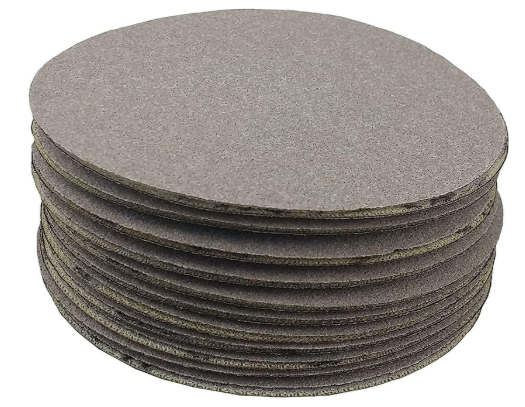
The 3″ Film Grip Sanding Discs 180 Grit, 50-pack from Polishing Systems Inc deliver aggressive, consistent material removal in a format that fits where the work actually is. At 180 grit, these are your first-step abrasive for body filler leveling, gel coat restoration, and paint removal in spot-repair panels — they cut fast, leave a scratch pattern that steps cleanly to 320 and then 400–800, and hold up in both wet and dry applications.
What These Discs Are
These are 3-inch, hook-and-loop polyester film discs rated at P180 grit. 180 grit is a mid-aggressive abrasive: fine enough to avoid gouging paint unnecessarily, aggressive enough to level body filler, remove heavy oxidation, and cut through gel coat for color-sanding prep. Film backing provides better performance than paper in wet applications, resists tearing when the disc is run at the edges of contoured panels, and sheds swarf more effectively — keeping the cutting surface active longer per disc.
Key Features and Why They Matter
- 3-inch format — fits bumpers, A-pillars, door jambs, and tight body curves where a 6-inch disc cannot access cleanly. Means fewer hand-sanding workarounds and more consistent results in small-area work.
- P180 aggressive cut — removes body filler high spots, heavy paint, and deep oxidation efficiently. Means less sanding time per panel before stepping up to finer grits.
- Film backing — polyester film holds its flat geometry under load and moisture, unlike paper which softens and flexes. Means more consistent scratch depth across the full cut area.
- Anti-loading coating — paint and filler residue ejects from the disc surface rather than packing in. Means each disc cuts longer before performance drops.
- Hook-and-loop attachment — mounts to any 3-inch backing plate securely with no slippage under orbital motion. Means fast disc changes during multi-grit sanding sequences.
- 50-disc pack — adequate working stock for active repair operations and mobile detailing rigs that run spot repairs weekly.
What These Discs Are NOT For
At 180 grit, these are too aggressive for finish sanding — do not use as your final abrasive step before machine polishing. 180-grit scratches require stepping through 320, then 400–800 before compounding can remove the scratch pattern. Do not use on chrome, bare aluminum, or glass. These are not suitable for PSA (pressure-sensitive adhesive) backing plates — hook-and-loop only. For tight-area finish work after leveling, step to the 3-inch 320-grit version.
Who Uses These Discs
Body shop technicians leveling body filler and spot-filling primer. Marine detailers restoring gel coat on boat hulls, transoms, and tight deck areas. RV detailers removing oxidized clear coat in recessed panels and trim edges. Mobile detailers doing spot paint correction on door handles, mirror caps, and bumper corners where orbital sanders with 5- or 6-inch pads cannot reach.
How to Use
- Surface prep: Wash the area. Body filler and primer should be fully cured before sanding.
- Attach disc to a 3-inch hook-and-loop backing plate — confirm firm, even seating.
- Sand at 3,000–4,500 OPM in overlapping passes, working across the repair area. Keep the backing plate flat — avoid tilting at the disc edge.
- Check progress frequently: Wipe clean and inspect. 180 grit cuts fast — do not over-sand.
- Step up through grits: Follow 180 with 320, then 400–600 if needed, then 800 or finer before compounding. Each step removes the scratches from the previous one.
- Finish: Machine polish with compound and a cutting pad to remove the finest sanding scratches and restore gloss. See the compound and polish lineup for pairing options.
Why Buy These vs. Standard Paper Discs
Paper-backed 3-inch discs soften, absorb moisture, and lose their flat geometry quickly in spot-repair work — especially when applied to curved surfaces under load. Film discs maintain dimensional stability, shed material more effectively, and last measurably longer per disc. At the 50-pack level, the cost per effective sanding minute is lower than buying individual paper discs. For shops doing regular repair work, switching to film backing typically reduces total disc consumption by 20–40% compared to equivalent paper grit. See the larger 6-inch 800-grit disc pack for finish sanding on flat panels.
Frequently Asked Questions
What backing plate do I need for these 3-inch discs?
You need a 3-inch hook-and-loop (grip) backing plate compatible with your orbital sander’s spindle. Most compact random orbital sanders accept a standard 5/16-inch or M8 spindle thread. Confirm your sander’s spindle spec before ordering a backing plate — the 3-inch size is the key variable here, not the thread.
Can I use these discs on gel coat?
Yes — gel coat is a primary application for 180-grit film discs on marine surfaces. Gel coat is harder than automotive clear coat, so 180 grit is appropriate as a starting point. Always wet-sand gel coat to reduce heat buildup and extend disc life. Follow up with 320, 600, and 800 before compounding to restore gloss.
How many discs per repair job?
A typical spot repair using 180 grit for body filler leveling on a palm-sized panel consumes 1–3 discs depending on filler depth and sander speed. For a full bumper or large panel section, plan on 5–10 discs at this grit. The 50-pack covers 10–25 average spot repairs, making it the right buy for shops doing repair work weekly.
Are these safe to use wet?
Yes — film backing resists water and does not soften or delaminate when used wet. Wet-sanding is recommended on gel coat and desirable on automotive paint to reduce heat and extend disc life. Use clean water or a sanding lubricant solution — avoid soap-heavy solutions that can leave residue.
What grit should I step to after 180?
Step to 320 grit next. A single grit jump from 180 to 400+ will leave 180-grit scratches that are difficult to remove with compound alone. The 180 → 320 → 600 → 800 sequence produces a smooth, predictable path to compounding. For the 320-grit 3-inch disc, see the 3″ 320 Grit Film Grip Sanding Discs.