
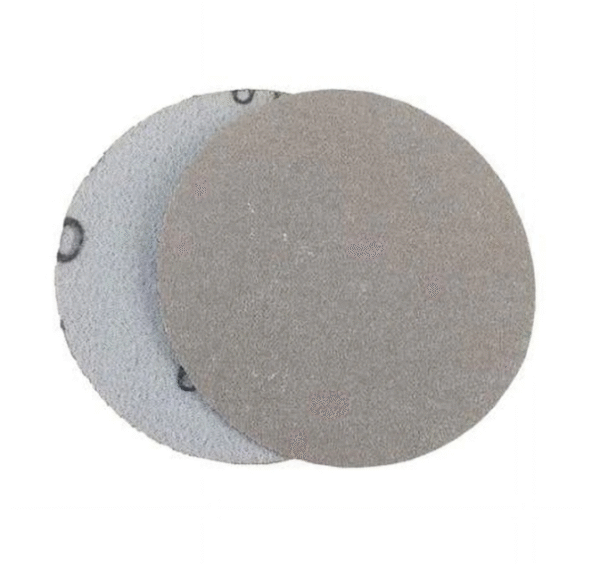
Between the aggressive cut of 180 grit and the precision finish of 600–800, the 320 grit step is where spot repairs are actually shaped. It removes the coarse scratches left by 180 while cutting down any remaining high spots, primer peaks, or texture irregularities — without going so fine that you are spending time on a scratch pattern that the next grit should handle. Getting this step right sets the ceiling for how good the final polish can be.
The 3″ Film Grip Sanding Discs 320 Grit, 50-pack from Polishing Systems Inc deliver consistent mid-cut performance in the 3-inch format built for tight areas, bumpers, pillars, and contoured body panels. The polyester film backing stays flat and active in both wet and dry applications, and the 50-disc pack keeps a full sanding sequence stocked without constant reordering.
What These Discs Are
These are 3-inch, hook-and-loop polyester film sanding discs rated at P320 grit. At 320 grit, these sit between aggressive material removal (180 grit) and precision finish sanding (600–800 grit). In a multi-grit sanding sequence, 320 is the step that refines 180-grit scratches into a pattern fine enough for 600 grit to manage quickly. For paint technicians doing primer sanding, 320 is also a standard leveling grit for high-build primers before sealer coats. Film backing provides better dimensional stability, moisture resistance, and anti-loading performance compared to paper at equivalent grit.
Key Features and Why They Matter
- P320 medium-cut grit — removes 180-grit scratches and primer texture efficiently without cutting deeper than needed. Means a clean transition to 600-grit finishing without rework.
- Polyester film backing — holds flat on contoured surfaces and resists moisture. Means consistent scratch depth across curved bumpers, pillars, and recessed trim areas where the disc must flex slightly.
- Anti-loading coating — paint, primer, and filler residue shed from the abrasive surface instead of packing in. Means each disc stays cutting longer, reducing total disc consumption per job.
- Hook-and-loop attachment — firm, slip-free connection to 3-inch backing plates. Means no disc movement under orbital load, and quick change during multi-grit sequences.
- 3-inch format — accesses bumpers, door jambs, A-pillars, and tight body contours that larger discs cannot reach cleanly. Means the work gets done where it is, not worked around.
- 50-disc pack — production-shop working quantity for operations doing spot repair regularly.
What These Discs Are NOT For
Do not use 320-grit discs as your final abrasive step before machine polishing. 320-grit scratches require at least one more sanding step (600–800 grit) before compound can remove the scratch pattern efficiently. These discs are not appropriate for aggressive material removal — use 80–180 grit for body filler leveling. Not compatible with PSA backing plates — hook-and-loop only. Do not use on glass, chrome, or bare aluminum without first verifying surface compatibility.
Who Uses These Discs
Body shop technicians who need a reliable 320-grit step between body filler work and primer application. Paint correction detailers doing spot repairs on OEM and refinished paint. Marine technicians sanding gel coat or primer on tight hull areas, locker doors, and transom panels. Mobile detailers carrying a compact 3-inch orbital for door-edge chips, bumper scuffs, and body line corrections where larger pads are impractical.
How to Use
- Confirm the surface is ready: Previous 180-grit sanding should be complete and primer/filler fully cured before applying 320.
- Attach disc to a 3-inch hook-and-loop backing plate — ensure full, even contact across the disc face.
- Sand at 3,000–4,500 OPM using overlapping passes. Keep the backing plate flat to avoid edge dig-in on curved surfaces.
- Check often: Wipe clean and inspect under bright light to verify 180-grit scratches are fully replaced with 320-grit marks.
- Step to 600–800 grit before moving to compound. For the complementary 6-inch 800-grit disc for flat panels, see the 6″ 800-grit Film Grip Sanding Discs.
- Follow with compound on a cut foam pad to remove the final sanding scratches and restore paint gloss.
Why Buy These vs. Generic Paper Discs
Paper-backed 320-grit discs load quickly with primer and paint residue, losing cutting efficiency mid-panel. Film backing sheds material consistently throughout the disc’s life, delivering the same scratch pattern from the first stroke to the last. For shops running multi-grit sequences on multiple cars per week, film discs at the 50-pack level are more economical per square foot of surface finished than buying individual paper sheets. The 3-inch 180-grit discs are the natural first step in the sequence these 320-grit discs continue.
Frequently Asked Questions
Is 320 grit fine enough to go straight to compound after sanding?
Not on most paint systems. 320-grit scratches are deeper than compound can fully remove in a single machine polishing pass without aggressive cutting that risks burning through the clear coat. The correct sequence is 320 → 600–800 grit → compound → polish. Skipping grits increases compound time and paint removal per correction pass.
Can I use these discs on sanded primer?
Yes — 320 grit is a standard primer-sanding grit for high-build and polyester primers before sealer coat application. Ensure the primer is fully cured (follow manufacturer’s dry time) before sanding, and confirm the primer’s recommended sanding grit — some primers require a coarser or finer grit for proper adhesion of the next coat.
Will these discs clog quickly on paint?
The anti-loading coating significantly delays clogging compared to standard paper discs at the same grit. On uncured or soft single-stage paint, loading is faster than on hard automotive clear coat or primer. If the disc begins to glaze over rather than cut, replace it — a loaded disc generates heat and scratches unevenly.
What random orbital sander is compatible?
Any 3-inch random orbital or dual-action sander with a hook-and-loop backing plate. Common compact models include the Milwaukee 2648-20, DeWalt DWE6423, and Mirka Deros 3-inch series. Confirm your sander’s backing plate diameter matches the disc size — 3-inch discs do not fit 5- or 6-inch backing plates.
How do these relate to the 180-grit 3-inch discs?
The 3-inch 180-grit discs are the first step for aggressive material removal, body filler leveling, and gel coat preparation. These 320-grit discs follow to refine the scratch pattern before stepping to 600–800. Both packs are the same film-backing format and hook-and-loop attachment — they work as a coordinated two-step system in tight-panel repair work.