
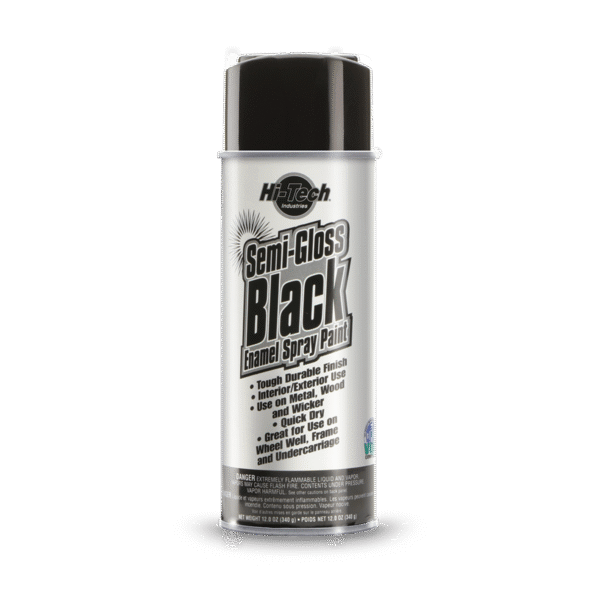
Flat black blends into the background. Gloss black demands attention. Semi-gloss black hits the right register for most engine bay and chassis work: it has enough depth and reflectivity to look intentionally finished without the mirror-sheen maintenance demands of full gloss on components that will accumulate road dust, oil mist, and shop grime within days of application. It is the factory-level detail finish that restoration and engine-bay correction work tends to reach for.
Semi-Gloss Black Enamel Spray Paint from Polishing Systems Inc is a heat-resistant aerosol enamel in a semi-gloss finish level, formulated for engine bay brackets, valve covers, intake components, frame rails, and underbody hardware. It provides a durable, chemically resistant finish with a finish level that reads as clean and quality without the visual maintenance burden of high gloss.
What This Product Is
Semi-Gloss Black Enamel is an aerosol spray enamel with a semi-gloss (low-to-mid sheen) finish level. The enamel formula is designed for mechanical components in engine bays and underbody applications — not for exterior body panel painting. Semi-gloss sits between the non-reflective appearance of flat/matte black and the mirror-like finish of high gloss: visible depth and sheen without the maintenance-intensive appearance of full gloss on working mechanical surfaces. Supplied in 12oz aerosol format.
Key Features and Why They Matter
- Semi-gloss finish level — depth and sheen without the full-gloss maintenance requirement. Means a visually finished appearance on mechanical components that stays looking intentional even as dust and minor contamination accumulate between cleanings.
- Heat-resistant enamel formula — rated for engine bay temperature cycling. Means the coating survives under-hood heat without blistering or peeling under normal operating conditions.
- Chemical resistance — resists engine oil, fluids, and shop chemical exposure. Means longevity in the working environment rather than just on freshly completed projects in a controlled setting.
- Consistent aerosol delivery — even spray pattern for uniform coverage on irregular bracket and cast surface geometry. Means no brush marks or uneven color on complex component shapes.
- 12oz aerosol can — appropriate size for individual component finishing and spot touch-up without significant product waste.
What This Is NOT For
Not for exterior automotive body panel painting or as a clear coat substitute — this is a mechanical component enamel. Not for exhaust system surfaces that exceed the product’s rated temperature limit. Surface preparation is essential — do not apply over grease, oil, active rust, or loose paint. For applications preferring no sheen, see the Flat Black Engine Enamel. For full gloss applications, see the Gloss Black Enamel.
Who Uses This Product
Restoration shops detailing engine bays where semi-gloss provides a period-correct or factory-spec appearance on brackets, ancillaries, and chassis components. Auto detail operations offering engine bay cleaning and refinishing as a premium service add-on. Enthusiast builders doing chassis prep and engine compartment presentation work. Marine mechanics painting engine mounts and mechanical brackets in boat engine compartments where a finished appearance without full gloss is preferred.
How to Use
- Prepare the surface: Degrease thoroughly, remove loose or flaking paint, sand raw metal and prime if needed. A properly prepared surface is the foundation of a quality finish.
- Mask adjacent components — wiring, rubber hoses, sensors, gaskets, and chrome or polished parts.
- Shake well for at least 60 seconds before spraying.
- Apply 2–3 thin coats from 10–12 inches, allowing the recommended flash time between coats.
- Allow full cure before heat cycling or exposing to chemical contact.
- For the full paint and coating lineup, see the paint and finishing supplies category.
Why Semi-Gloss vs. Flat or High Gloss
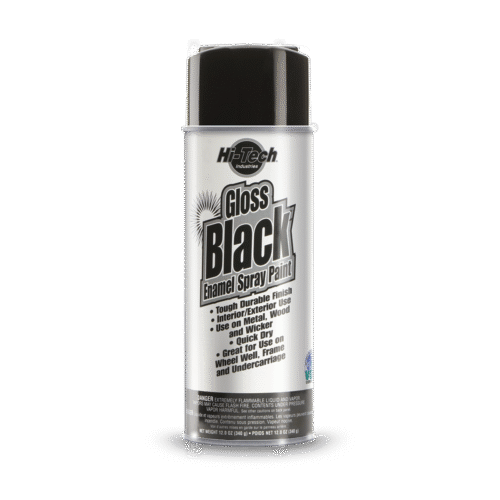
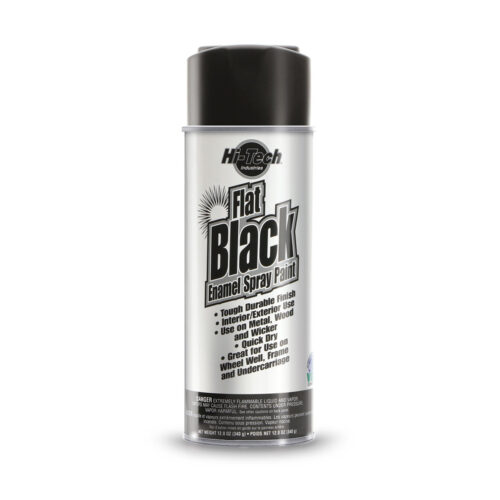
Flat black is the low-maintenance standard for components that need a clean appearance without visual emphasis — it hides texture and does not draw attention to itself. High gloss demands constant upkeep to look good, as every fingerprint, dust mote, and minor contamination shows on a mirror surface. Semi-gloss is the working compromise: it looks intentionally finished and has visual depth, but it does not require the fastidious maintenance of full gloss to look presentable in a detail photo or show bay. For shops and builders who want a step above flat without the commitment of full gloss, semi-gloss is consistently the right call. See the full black enamel family: Flat Black and Gloss Black.
Frequently Asked Questions
Can I clear coat over semi-gloss black enamel to increase the sheen?
Applying a compatible clear coat over cured semi-gloss enamel can increase sheen level toward gloss. Confirm compatibility between the enamel and clear coat chemistry before applying — incompatible topcoats can cause lifting, crazing, or adhesion failure. Allow the enamel to fully cure per label requirements before clear coat application.
How does semi-gloss compare to gloss for engine bay photos and shows?
Gloss black provides maximum visual impact in photographs and show presentations due to its reflectivity. Semi-gloss provides a finished, professional appearance with less reflection — it photographs well without the hot spots and mirror reflections of full gloss. For competition show cars where maximum visual impact is the goal, full gloss is the stronger choice. For resto-mod and daily driver engine bay detailing, semi-gloss is the more practical and consistent finish.
Is primer required before applying this enamel?
On bare metal, primer is recommended for best adhesion and corrosion protection under the enamel layer. On previously painted surfaces in good, tight condition, light scuff-sanding and direct enamel application is typically adequate. On heavily rusted or raw aluminum surfaces, primer is strongly recommended as the first step.
How many cans does it take to paint a complete engine bay?
A complete engine bay freshening with 2 coats typically uses 3–5 cans depending on the complexity of the components, the coverage area, and how many brackets and ancillaries are being painted. For a single large component like an intake manifold or valve cover, 1–2 cans is usually sufficient. Budget cans conservatively — running short mid-project forces a color-match gamble on the next can from a different batch.
What is the dry time between coats?
Follow the specific label instructions for this product. Most aerosol enamels in this category have a 5–10 minute recoat window for wet-on-wet application and a 30–60 minute window for dry recoat. Do not apply additional coats over a partially set enamel layer — the partially cured layer will wrinkle under fresh solvent from the new coat. When in doubt, wait longer between coats.