
In a two-step correction sequence — compound then polish — the polish step is where clarity gets built. The compound handled the defect removal; now the job is refining the micro-scratches left by the compound into something the eye cannot detect at normal viewing distance, and developing the reflectivity and depth that professional correction results are known for. The pad in that step needs to be soft enough to refine without reintroducing marks, and firm enough to work the polish into a corrective action rather than just spreading product on the surface.
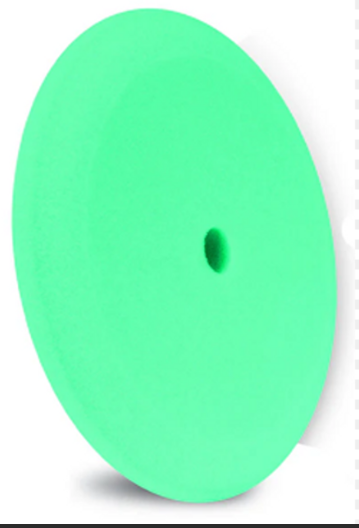
The 9″x1.5″ Green Contour Foam Grip Pad hits that balance. Medium-soft foam density positions it between the aggressive cutting category and the ultra-soft finishing tier — the working range of a polishing pad that is expected to both remove post-compound haze and finish to genuine clarity in a single pass.
What This Pad Is
This is a 9-inch diameter, 1.5-inch thick medium-soft foam polishing pad with a contoured face profile and hook-and-loop grip backing. Green in the standard professional foam pad color system indicates the polishing tier — positioned above finishing (black/white) and below cutting (yellow/orange). Polishing pads are used with medium polishes to refine compound micro-scratches, remove light swirls on well-maintained paint, and develop surface gloss before the final finishing step or before protection application.
Key Features and Why They Matter
- Medium-soft green foam density — provides enough working action to remove compound haze and light swirls while finishing cleaner than a cutting pad. Means fewer steps in a well-sequenced correction workflow — compound on cut pad, then polish on this green pad, and the surface is ready for protection or a final jeweling pass.
- 9-inch diameter — covers large panel areas efficiently. Critical for production shop throughput on full-size vehicles where smaller pads require significantly more passes to cover the same area.
- Contoured face profile — maintains contact across body panel curves and transitions. Flat pads lose contact at the apex of curved surfaces, leaving unpolished stripes that require rework.
- 1.5-inch foam thickness — provides cushion depth for vibration absorption and consistent pad face pressure across uneven panel surfaces.
- Standard hook-and-loop backing — compatible with 8-inch and 9-inch backing plates on all major professional polisher platforms.
What This Pad Is NOT For
The green polishing pad is not a cutting pad. Deep defects, 1200-grit sanding marks, severe oxidation, or significant paint film loss require a cutting compound on a wool or foam cutting pad first. A polishing pad on heavy defects will smear product without correcting the defect, and the resulting surface will look worse under proper inspection lighting than before treatment. Also not recommended as a single-step solution on severely neglected paint — reserve the green pad for the polish step after a proper compound phase.
Who Uses This Pad
Two-step correction specialists, pre-owned vehicle reconditioning shops, and mobile detailers running one-step services on paint in good condition all use polishing foam pads as core workflow tools. For high-volume correction work, using the green polishing pad between the Yellow Light Compounding Pad and the White Finishing Pad creates a complete three-pad, three-step correction sequence for the full defect range.
How to Use
- Use after the compound step — or as a first step on paint with only light defects and swirls.
- Pair with a medium polish appropriate for the paint system and defect level.
- Prime the pad with 4-5 drops of product spread across the face at low speed before working.
- Work at medium speed — DA: speed 3-4 of 6. Rotary: 1,000-1,400 RPM with light-to-moderate pressure.
- Work in 2×2-foot sections, wipe and inspect between sections.
- Follow with a finishing step if maximum clarity is needed, or proceed to protection if the finish level is acceptable after polishing.
Why Buy This vs. Consumer Store Pads
Consumer foam pads are typically softer and less dimensionally consistent than professional pads — they spread product but rarely develop corrective action on swirls and compound haze because the foam density is insufficient. Professional medium-soft polishing foam maintains the firmness needed to apply mechanical pressure through the polish product while finishing clean. The full contour pad lineup from Polishing Systems Inc is coordinated for use as a complete correction system.
Frequently Asked Questions
Can the Green Contour Pad be used for one-step correction on newer vehicles?
Yes — on paint with only light swirling, water spots, or oxidation from one or two seasons of neglect, the green polishing pad with a medium polish or AIO compound can serve as the only correction step before protection. Test on a small section first to confirm the single-step approach is achieving the defect removal you need.
How does the green pad compare to the blue contour pad?
Both the green and blue contour pads are in the polishing range, but blue is positioned slightly firmer and toward the polishing/finishing transition, while green is a classic medium-soft polishing foam. For most two-step correction workflows, the green pad is the standard polishing choice after compounding.
Does this pad work with AIO (all-in-one) products?
Yes — AIO compounds applied with a medium-soft polishing pad produce better correction and gloss development than AIO on a finishing pad. The green foam provides enough working action to activate AIO abrasives while still finishing cleanly enough for the product’s protective layer to bond properly.
How do I know when this pad needs to be replaced?
Replace when you notice foam delamination from the backing, visible compressed or hardened spots across the face, or a decline in polish performance that cleaning does not resolve. Well-maintained polishing pads typically provide 20-40 full correction sessions before performance degradation becomes noticeable.
What cleaning method works best for medium-soft foam polishing pads?
During use, brush the face at low speed with a firm pad brush every few panels to clear product loading. After the job, hand-rinse or machine-wash in cold water with a pad-safe cleaner. Squeeze (do not wring) to remove excess water and air dry face-up. Never machine dry.