
The transition step between polishing and finishing is where correction sequences either gain or lose efficiency. A pad that is too firm for the step reintroduces micro-scratches; a pad that is too soft does not develop enough corrective action to remove post-compound haze. The blue polishing/finishing pad is positioned specifically at that transition — its foam density sits between the standard polishing range and the ultra-soft finishing tier, making it a genuinely flexible choice for the middle and final stages of a correction sequence.
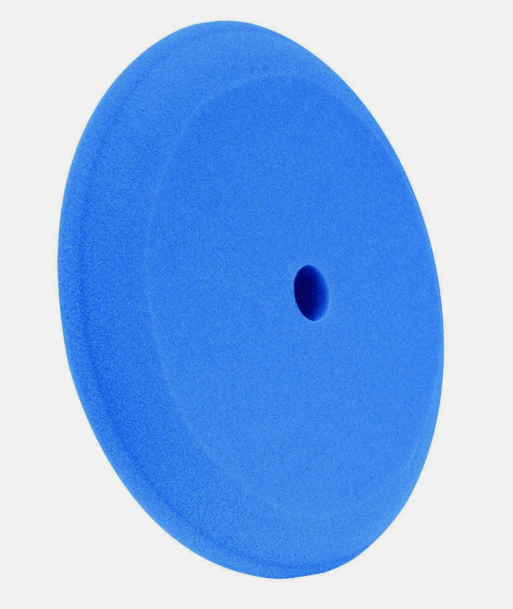
The 9″x1.5″ Blue Contour Foam Grip Pad is a professional dual-purpose foam pad that handles swirl refinement after compounding and can serve as a final finishing step before protection on many paint systems without requiring an additional pad swap. For shops that want to reduce pad count without sacrificing result quality, this is the pad that earns the most versatile position in the correction sequence.
What This Pad Is
This is a 9-inch diameter, 1.5-inch thick foam pad positioned at the polishing/finishing boundary. Blue in many professional foam pad systems indicates a balanced intermediate density — neither the medium-soft of a pure polishing pad nor the ultra-soft of a pure finishing pad. The contoured face profile allows the pad to follow curved body panels rather than riding flat across them, which is critical for even product distribution on cars with pronounced styling lines and curvature.
Key Features and Why They Matter
- Polishing/finishing intermediate density — works a medium or finishing polish hard enough to refine compound micro-scratches while producing a final surface that does not require a separate finishing pad step on firm paint systems. Saves one pad swap per vehicle on a well-matched 2-step sequence.
- 9-inch panel-covering diameter — large enough for one-pass coverage of most door panels and efficient multi-pass coverage of hoods and roofs. Reduces total machine time compared to smaller 6-inch or 5-inch pads.
- Contoured face — active contact across body panel curves, not just at flat centers. Uniform gloss development requires uniform pad contact, and the contoured face provides that across complex panel geometry.
- 1.5-inch foam thickness — vibration absorption and consistent pressure distribution. Thinner pads transmit machine vibration more directly, which can produce uneven surface treatment on textured or non-flat panels.
- Hook-and-loop grip backing — compatible with 8-9 inch professional backing plates across all major polisher platforms.
What This Pad Is NOT For
The blue polishing/finishing pad is not a cutting pad. Heavy defects, deep sanding marks, and severe oxidation require a cutting compound on a wool or foam cutting pad before this pad enters the sequence. Attempting to correct heavy defects with a polishing/finishing pad produces frustrated results — the product loads without correcting, and the surface looks uniformly hazed rather than corrected. Also, on extremely soft single-stage paints, even a polishing/finishing foam can leave light haze that requires a softer finishing-only pad to resolve.
Who Uses This Pad
The blue polishing/finishing pad is the right choice for detailers who want to simplify their pad lineup without compromising the result on firm or medium-firm paint systems. It is particularly popular with mobile detailers running compact kits where carrying a 4-5 pad sequence per vehicle size is impractical. For shops running full three-step correction, use the Yellow Compounding Pad for cutting, the Green Polishing Pad for standard polish, and the blue for the final gloss-developing pass.
How to Use
- Position in sequence — use after compound (cutting) step to refine, or as the only mechanical step on well-maintained paint with light defects.
- Pair with a medium or finishing polish matched to the paint system and defect level.
- Prime the pad — 4-5 drops spread at low speed before working the section.
- Machine speed — DA: speed 3-4 of 6. Rotary: 1,000-1,300 RPM, light-to-moderate pressure.
- Work in 2×2-foot sections, wipe and evaluate under lighting before applying protection.
Why Buy This vs. Consumer Alternatives
Consumer pads sold in automotive retail chains are typically inconsistent in foam density from pad to pad — even within the same color designation. For consistent correction results across a day’s work, pad-to-pad consistency matters. The contoured face design is also a professional feature not commonly found on retail pads, and on curved European or Asian vehicles with aggressive body styling, it produces meaningfully better contact than flat-face alternatives. See the complete 9-inch contour pad lineup for the full correction sequence.
Frequently Asked Questions
Is the blue pad a polishing pad or a finishing pad?
It is both — intentionally positioned between those two categories. On firm OEM clear coat paint, it can serve as the final mechanical step before protection. On softer paint or for maximum-gloss show results, follow the blue pad with an ultra-soft finishing pass using the White Finishing Pad.
Can this pad be used for AIO (all-in-one) compound application?
Yes. The blue pad’s intermediate density is well-suited for AIOs — firm enough to work the abrasive component and develop correction, soft enough to allow the protective layer to bond. It is one of the most recommended pads for one-step AIO enhancement services.
How often should I clean this pad during a job?
Clean by brushing the pad face at low machine speed every 2-3 panel sections, or when you notice product loading reducing the pad’s working action. For extended jobs, use a pad washer or rinse the pad and allow it to partially dry before reuse to restore full foam loft.
Will this pad work on gel coat as well as automotive paint?
Yes — marine gel coat polishing is a common application for 9-inch foam polishing pads. Gel coat is typically harder than automotive clear and may require a medium polish with more cutting action than a light finishing formula. Use at medium machine speed and check correction progress frequently on gel coat, as it can appear deceptively clean before proper clarity is achieved.
Is the 9-inch size compatible with a Rupes LHR21 or similar large DA polisher?
Yes — the Rupes LHR21 and similar large-orbit DA polishers are designed for 9-inch pads and are one of the primary platforms this pad is used on professionally. The large orbit and 9-inch pad combination is particularly effective for correction and polishing on large panels.