
The finishing pad is the last mechanical contact your machine makes with the paint before it goes to the customer. Whatever swirl pattern, hologram, or micro-marring that pad leaves is what the customer sees in the sun. Foam finishing pads are gentle — they also lack the microfiber’s mechanical finishing action that produces the sharper, higher-gloss surface that a well-dialed microfiber finishing step achieves on clear coat and gel coat. This is why professional paint correction shops often replace the foam finisher with a microfiber finisher as the last machine step before a panel inspection.
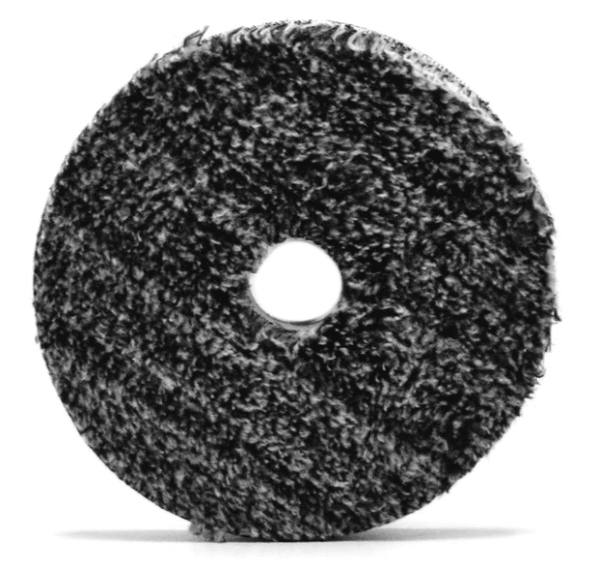
The Uro-Fiber 5″ Finisher Black Microfiber Pad from Polishing Systems Inc is the full-size panel finishing pad in the Uro-Fiber lineup. At 5 inches, it works across standard panel areas on a DA polisher or rotary with a 5-inch backing plate. The black face designation identifies it as the finishing step in a multi-pad correction sequence. The microfiber face construction delivers the final surface refinement that distinguishes a properly corrected panel from one that still carries light abrasive traces from earlier correction steps.
What This Pad Is
A 5-inch diameter black microfiber finishing pad with hook-and-loop backing for 5-inch DA polisher backing plates and compatible rotary setups. The microfiber face is the finishing-grade construction — designed for the final polish pass with a finishing-grade product to bring the surface to maximum refined gloss. The black color designates this as the final-step pad in the Uro-Fiber correction system.
Key Features and Why They Matter
- Black face — finishing designation — the final-step pad in the Uro-Fiber system. Use after cutting and polishing pads to refine the surface to finished quality.
- 5-inch working format — full panel coverage on a standard DA polisher backing plate. Efficient finishing passes across doors, hoods, and large flat panel areas.
- Microfiber finishing construction — microfiber’s mechanical fiber action produces a sharper, higher-quality finished surface on clear coat and gel coat compared to foam finishing pads at equivalent machine settings.
- DA and rotary compatible — the hook-and-loop backing and pad construction work with both random orbital (DA) polishers and controlled rotary machines with 5-inch backing plates.
- Washable and reusable — professional microfiber pad construction handles repeated washing and reuse through many paint correction sessions with proper care.
What This Is NOT For
Not for heavy cutting or compound application — this is a finishing pad, not a cutting pad. Using heavy compound with a finishing pad will not achieve the correction depth the compound is capable of and will load the finishing pad prematurely. Always sequence correctly: cutting pad and compound for defect removal, polishing pad and medium polish for swirl and compound residue removal, finishing pad and finishing polish for final surface refinement. Not for use on leather, vinyl, or interior surfaces.
Who Uses Uro-Fiber 5″ Finisher Pads
Professional paint correction specialists using the Uro-Fiber system for 2-step and 3-step paint correction on full panels. Detail shops that polish every vehicle before delivery and want the best available surface quality from their finishing step. Ceramic coating installers who need the surface as refined as possible before coating application. Marine detailers finishing gel coat after compounding. For the small-format versions of the Uro-Fiber pad system, see the 3″ Finisher 2-Pack and the 2.25″ 4-Pack.
How to Use
- Complete all cutting and polishing steps before switching to the Uro-Fiber Finisher Black pad.
- Mount the pad on a 5-inch hook-and-loop backing plate. Confirm center alignment before powering the machine.
- Apply a small amount of finishing polish to the pad face or to the panel — 3-5 pea-sized drops for a typical 2-foot section.
- Spread product at low speed (speed 1-2 on DA polisher) to distribute without sling before increasing to working speed.
- Work in overlapping passes across the panel section at finishing speed — typically speed 3-4 on a DA polisher. Higher speeds are generally not needed or beneficial on the finishing step.
- Inspect the finished section in appropriate lighting before moving on — the finishing step should produce zero or near-zero residual swirl and maximum gloss.
Why Microfiber Finisher vs. Foam Finisher
Foam finishing pads are gentle and produce good results on most correction sequences. Microfiber finishers produce a sharper, more refined surface on clear coat — the fiber structure provides a different mechanical finishing contact than closed-cell foam, resulting in higher gloss and reduced hologram residue from the prior polishing step. For shops and installers where surface quality at the finishing step matters most — especially before ceramic coating application — the microfiber finisher is the professional tool of choice for the last machine pass.
Frequently Asked Questions
Can I use this pad with an all-in-one (AIO) compound?
Yes — AIO compounds (paint cleaners with mild abrasives and gloss enhancers) work well with a microfiber finishing pad on paint that is in good condition and needs a one-step refresh rather than multi-step correction. For paint with significant defects, a full multi-step correction sequence with appropriate cutting pads is more appropriate before the finishing pad pass.
How many correction sessions does a 5″ microfiber finishing pad last?
With proper care — immediate rinsing after use, hand washing, air drying, proper storage — a quality microfiber finishing pad provides 15-25+ correction sessions before noticeable performance degradation. Microfiber that is allowed to dry with compound or polish loaded in it, or that is machine-washed at high temperature, degrades significantly faster.
Is this pad safe for use on single-stage paint?
Yes — the finishing-grade microfiber construction is appropriate for single-stage paint. Use with a finishing polish appropriate for single-stage. Be aware that single-stage paint is often softer than clear coat and may respond more quickly to machine work — use lower machine speed and lighter pressure and monitor the panel more frequently than on harder clear coat systems.
What backing plate pairs with this pad?
Standard 5-inch hook-and-loop backing plates for DA polishers are the correct pairing. The backing plate provides the attachment surface that the pad’s hook-and-loop back bonds to. Ensure the backing plate is clean, free of contamination, and in good hook-and-loop condition for secure pad attachment during use.