
After a compounding and polishing pass, most paint looks dramatically better — but the transition from “polished” to “perfect” often requires one more step before wax. A finishing glaze fills the micro-hazing and fine swirls that remain after cutting and polishing, levels the paint surface optically, and sets up the paint for the deepest possible gloss response from the wax or sealant applied on top. It is the step that separates a thorough paint correction from a truly finished one.
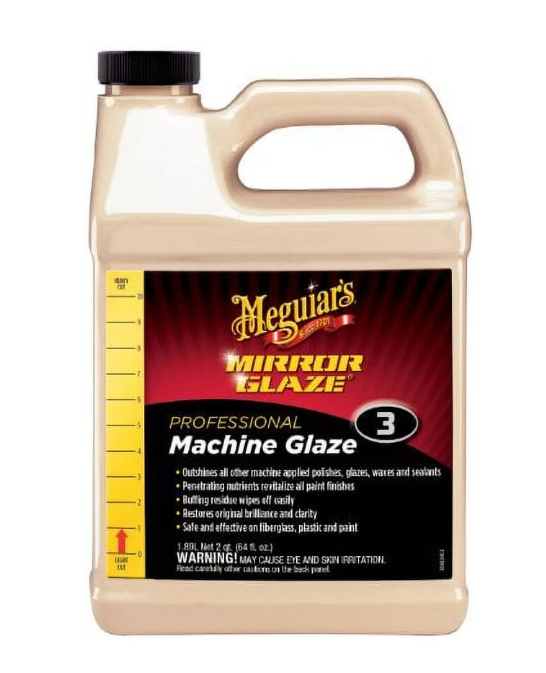
Meguiar’s Machine Glaze 64 oz (M0364) is Meguiar’s professional machine-applied glaze for that finishing step. Using Meguiar’s Optical Modifier Technology, it fills surface micro-imperfections with optical fillers, enhances gloss depth, and leaves a high-clarity surface with the characteristic wet, mirror-like appearance that Meguiar’s finishing products are known for. The 64oz professional size is the shop-appropriate volume for active paint correction operations.
What Machine Glaze Is
Machine Glaze is a filling-type paint finishing product that combines optical fillers with surface conditioners to fill fine swirls, light scratches, and surface micro-hazing left after compounding and polishing. It is not a compound — it does not remove significant paint defects by abrasion. It is applied after paint correction to maximize gloss and fill remaining surface imperfections before applying protection.
Key Features and Why They Matter
- Optical Modifier Technology — Meguiar’s filling and surface-leveling formulation that improves gloss depth and surface clarity. The result is a paint surface that reflects light more uniformly, increasing the perceived depth and wetness of the finish.
- Machine application — designed for orbital dual-action (DA) and rotary polisher application with a finishing pad. Machine application ensures even product distribution and proper working of the glaze into the paint surface.
- Fills micro-hazing and fine swirls — addresses the surface imperfections that remain after compounding and polishing but require a different approach than more abrasive correction: optical filling rather than abrasive removal.
- 64oz professional size — the right volume for paint correction shops that use Machine Glaze regularly. Significantly more economical than repeated retail-size purchases.
What Machine Glaze Is NOT For
Not a substitute for compounding and polishing on paint with deep scratches, heavy oxidation, or significant swirl marks — those defects require abrasive correction before glaze. Not a paint protection product — apply wax, sealant, or ceramic coating over Machine Glaze after glazing to provide protection. The optical fillers in Machine Glaze are not permanent — they are a visual enhancement step that must be sealed with a protection layer.
Who Uses Machine Glaze
Paint correction specialists completing the finishing step of a multi-stage paint correction sequence. Detail shops offering high-end paint correction and show preparation services. Concours preparation detailers where maximum gloss depth and optical clarity are the deliverable. Body shops using glaze to finalize paint finish after compounding and polishing new paint.
How to Use
- Start after compounding and polishing: Machine Glaze is applied as a finishing step after the paint has been corrected to the desired level. Paint should be clean and free of oils.
- Select finishing pad: Use a soft foam finishing pad or a Meguiar’s W9006 or equivalent soft pad. Do not use a cutting pad with Machine Glaze.
- Apply to pad: Place a small amount (2–3 pea-sized drops) on the pad for a standard 18″x24″ panel section.
- Spread at low speed: Spread the product at low polisher speed (speed 1–2 on a DA polisher) to avoid throwing product before working it in.
- Work at medium speed: Increase to medium speed (speed 3–4) and work the product across the panel with overlapping passes.
- Remove with microfiber: Wipe off with a clean, plush microfiber towel while the product is still workable (before it hazes over completely).
- Apply wax or sealant: Follow immediately with your selected protection product while the paint surface is clean and prepared.
Why Buy Meguiar’s Machine Glaze vs. Consumer-Grade Finishers
Meguiar’s professional product line is formulated at professional concentration for consistent, repeatable results in production detailing environments. Consumer-grade Meguiar’s products are available at retail but are often diluted relative to the professional lineup. The 64oz M0364 professional size provides the same Optical Modifier formula in a shop-appropriate volume that reduces per-panel cost significantly versus retail sizes. For full paint correction supplies including compounds, polishes, and foam pads, browse the complete lineup.
Frequently Asked Questions
Can Machine Glaze be applied by hand?
Yes — while designed for machine application, Machine Glaze can be applied by hand with a foam applicator pad on smaller panels or tight areas where a machine polisher cannot reach. Machine application provides more consistent results and better working of the product on larger panel surfaces.
Does Machine Glaze provide any protection?
Machine Glaze is a finishing and filling glaze — it enhances gloss and fills surface micro-imperfections. It provides minimal standalone protection. Always follow with a wax, paint sealant, or ceramic coating for actual surface protection after glazing.
How long does Machine Glaze last on the paint?
The visual enhancement from Machine Glaze lasts as long as the protection layer applied over it. The optical fillers remain effective until the wax or sealant on top is stripped by washing or environmental exposure. Reapplying protection maintains the finish Machine Glaze creates.
Is Machine Glaze safe on single-stage paint?
Yes — Machine Glaze is appropriate for both single-stage and clear-coated paint systems. On single-stage paint, which is more porous and subject to oxidation, the glaze filling effect is often more dramatically visible than on clear-coated paint in good condition.
What pads work best with Machine Glaze?
Soft finishing foam pads (white or light-colored pad foams in the Uro-Tec and similar systems) are the appropriate pad for Machine Glaze. Avoid cutting or medium-cut pads — the soft pad delivers the product without introducing new marring at the glazing step.