Cleaning is only half of leather maintenance. Every time leather is cleaned — or simply exposed to sun, heat, and repeated contact — it accumulates contamination that quietly degrades the surface coating and dye layer underneath. Body oils, sweat, sunscreen, and denim dye work into the surface coating with every mile. Left to accumulate, these deposits break down the leather’s protective finish, darken and stiffen the grain, and eventually cause cracking that no amount of conditioner will reverse. The right leather cleaner removes contamination before it becomes damage.
What Leather Cleaner Is
This is a pH-balanced automotive leather cleaner designed for treated and finished automotive, marine, and RV leather — the type found in seats, door panels, dashboards, steering wheels, and armrests. The formula lifts body oils, sweat, sunscreen residue, product buildup, and general soiling from the leather surface without attacking the dye layer or surface coating. It is not a conditioner — it cleans. Always follow with a leather conditioner to restore flexibility and protection.
Key Features and Why They Matter
- pH-balanced formulation — aggressive cleaners that are too alkaline or acidic strip leather dyes and degrade surface coatings. A balanced pH cleans effectively without breaking down the finish over repeated use.
- Effective on body oils and sweat — targets the specific type of contamination that dominates in automotive leather: protein-based soiling from skin contact on seats, steering wheels, and armrests.
- Does not require rinsing — wipe-on, wipe-off application with a microfiber. No water rinse needed after cleaning.
What This Product Is NOT For
This is a leather cleaner for treated, finished automotive leather. Do not use on aniline, nubuck, or suede — open-pored leathers that require different chemistry and technique. Not appropriate for vinyl or synthetic leather (pleather/leatherette). Always follow leather cleaning with a leather conditioner — cleaning removes oils; the leather needs conditioner to replace them. Do not allow to pool in seams or stitching for extended periods.
Who Uses Leather Cleaner
Mobile detailers performing leather cleaning as part of interior detail services. Dealership reconditioning teams cleaning leather on incoming trade-in and pre-owned vehicles. Detail shops offering premium interior packages with leather-specific care. Boat detailers maintaining marine cabin seating. Enthusiasts maintaining their own leather interior on a regular schedule.
How to Use
- Apply to applicator: Spray or pour a small amount onto a soft applicator pad, soft-bristle brush, or folded microfiber.
- Work in sections: Clean one seat section, door panel, or armrest at a time in a gentle circular or back-and-forth motion.
- Wipe clean: Remove the lifted contamination with a clean dry microfiber. Use a fresh section of towel for each wipe.
- Repeat if needed: Heavily soiled areas may require a second pass. A soft-bristle interior brush helps agitate accumulated body-oil buildup on driver seat bolsters.
- Follow with conditioner: Apply leather conditioner to restore suppleness and protection after cleaning.
Why the 5-Gallon Pail
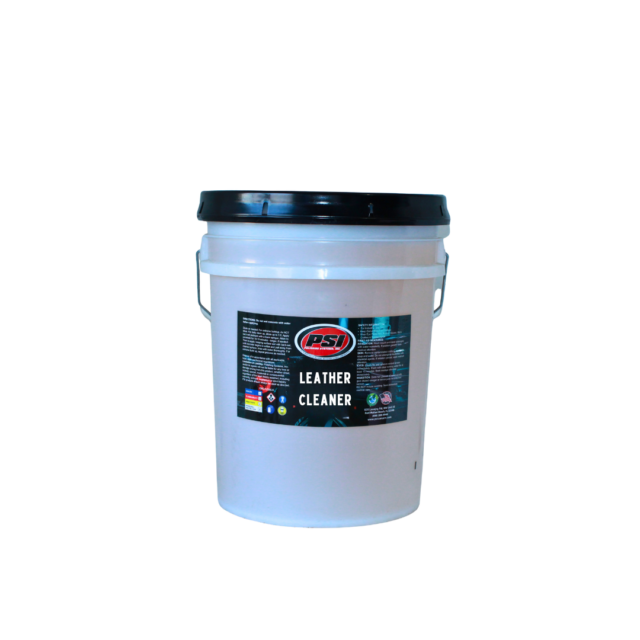
The 5-gallon pail is the working format for high-volume detail operations, dealership reconditioning centers, and fleet maintenance bays where leather cleaning is performed multiple times per day. Dispensing into quart spray bottles for individual vehicle use from a central pail keeps per-application costs at their lowest in the Leather Cleaner product line. For individual detailers or smaller shops, see the 1-gallon, 32oz quart, or 16oz sizes. Always complete the clean-and-condition workflow with Leather Conditioner 1 Gallon.
Why Buy Leather Cleaner vs. General Interior Cleaner
All-purpose interior cleaners are formulated for hard plastics and carpet — surfaces that tolerate higher pH and more aggressive detergents. Leather has a surface coating and a dye layer that those cleaners degrade over time. Leather Cleaner is formulated specifically to clean without attacking either layer, preserving leather appearance and flexibility across many cleaning cycles.
Frequently Asked Questions
Do I need to dilute Leather Cleaner before use?
No — Leather Cleaner is ready to use at full strength. Apply directly to the applicator or leather surface. For very lightly soiled leather during maintenance cleaning, a light application is sufficient; for heavily soiled leather on reconditioning work, apply more generously and allow a 15–30 second dwell before agitating.
Can I use Leather Cleaner on perforated leather seats?
Yes, with care. Apply to a microfiber and wipe — do not spray directly into perforations. Use a low-moisture technique and wipe dry promptly. Follow with conditioner immediately after cleaning.
How often should automotive leather be cleaned?
In a daily driver, leather surfaces that are regularly contacted — seats, steering wheel, armrests — should be cleaned every 4–8 weeks. High-use commercial or rental vehicles may need monthly cleaning. Vehicles with infrequent use can go 2–3 months between cleanings.
Does Leather Cleaner work on marine cabin leather?
Yes — Leather Cleaner is appropriate for finished leather in marine cabin environments. It removes sunscreen, salt residue, and humidity-driven mildew staining. Always follow with conditioner and ensure the leather dries fully after cleaning.
What sizes is Leather Cleaner available in?
Leather Cleaner is available in 16oz, 32oz quart, 1 gallon, and 5 gallon — from mobile detailer carry size to high-volume shop purchasing.