
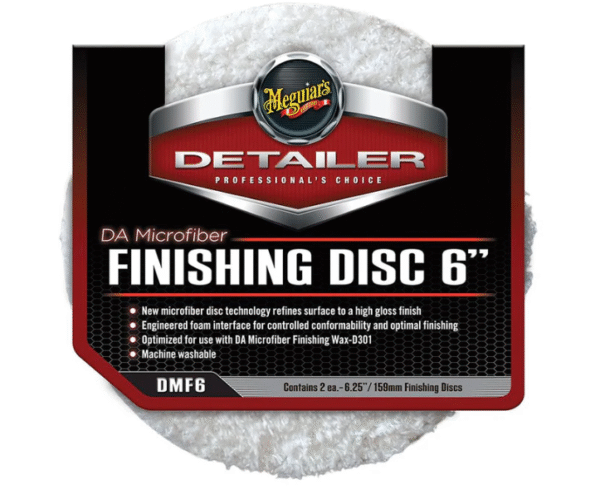
After a cutting pass, the paint surface is improved but not finished. Cutting discs and compounds remove defects, but they also leave behind a level of micro-marring and haze that needs to be refined before the paint is ready for inspection or protection. The finishing disc step is what takes paint from “defect removed” to “actually looks great” — and the microfiber finishing face does that refinement more effectively than foam finishing pads on a DA machine.
The DA Microfiber Finishing Disc 6″ (2-Pack) is the final-stage component of a complete DA microfiber correction system. The 6-inch diameter is the standard working size for main panel finishing — hoods, roofs, doors, quarter panels, and trunk lids. Each disc in the 2-pack delivers the microfiber-quality finish refinement that completes a paint correction sequence and produces the mirror-like gloss that distinguishes professional correction from basic polishing.
What DA Microfiber Finishing Discs Are
These are the second stage of a DA microfiber correction system. After cutting discs remove defects, finishing discs remove the micro-level haze and fine abrasive marks left by the cutting process. The microfiber finishing face engages with finishing polish at a finer level than foam, producing higher surface clarity in fewer passes. On a DA polisher with a quality finishing polish, a microfiber finishing disc typically produces better results than a foam white pad on the same machine.
Key Features and Why They Matter
- Microfiber finishing face — finer refinement than foam finishing pads at the same DA speed. So what? Higher surface clarity before coating means better coating bond and better visual result at delivery.
- 6-inch working diameter — the standard size for main panel finishing. Covers large surfaces efficiently and pairs with the 6-inch cutting disc for a complete 2-step correction workflow on main panels.
- 2-pack format — practical quantity for individual correction jobs. For high-volume shops, the 12-pack bulk case reduces cost per disc.
- Hook-and-loop backing — attaches to standard 6-inch DA backing plates. No special hardware.
- Works with finishing polishes and light glazes — formulated compounds at the finishing weight are the right pairing. Do not use with heavy cutting compounds.
What These Are NOT For
Finishing discs are not for defect removal — use a microfiber cutting disc first if paint has deep swirls, oxidation, or sanding marks. For tight panel sections and pillars, use the 5-inch microfiber finishing disc. Do not use on matte or satin finishes. Do not use with heavy cutting compounds — the finishing disc face is designed for light polish application.
Who Uses These
Detailers completing a 2-step or 3-step DA correction sequence who need a professional-grade finishing disc for the final step, shops running paint correction services where the finish quality is inspected before delivery, ceramic coating applicators who require a haze-free surface before coating, and mobile detailers building a complete DA microfiber correction kit.
How to Use
- Complete cutting step first if paint has defects requiring removal. Switch to the finishing disc after cutting is complete and residue is wiped clean.
- Apply finishing polish to the disc — a small amount. Microfiber holds product well; excess polish drags and marks the surface.
- Run at low to medium DA speed (speed 3–4). Finishing work requires less machine speed than cutting.
- Work in overlapping passes across the panel until haze is cleared and gloss is consistent.
- Wipe with a clean microfiber and inspect in good lighting. Repeat if haze patches remain.
- Apply protection (wax, sealant, or ceramic coating) once the surface passes inspection.
Frequently Asked Questions
Can I skip the cutting step and use just the finishing disc?
On paint in good condition — no deep swirls or oxidation, just light hazing — yes. The microfiber finishing disc with a finishing polish can be used as a standalone step to enhance gloss and clarity without a prior cutting phase. When real defect removal is needed, a cutting disc is required first.
How many correction cycles does each disc last?
With proper cleaning after each session, a microfiber finishing disc typically lasts 8–20 correction sessions before the face becomes matted enough to affect performance. Finishing discs tend to last longer than cutting discs because finishing polish is less aggressive and loads the fiber more gradually than cutting compound.
What is the difference between 6″ 2-pack and the 12-pack bulk case?
The 2-pack is the right format for individual jobs and mobile kit restocking. The 12-pack bulk case is for shops running finishing discs regularly enough that per-disc cost is meaningful. The 12-pack delivers meaningfully lower per-disc pricing than 6 individual 2-packs.
Do microfiber finishing discs work on gel coat?
Yes — microfiber finishing discs work on marine fiberglass gel coat for the finishing step after compound cutting work. Use a finishing polish appropriate for gel coat and follow the same workflow as on automotive clear coat. Gel coat is generally softer than modern automotive clear coat, so use light machine pressure on the finishing pass.
What cleaning method extends finishing disc life the most?
Rinsing immediately after each session before polish dries in the fibers, using a pad conditioning brush during use to keep the face from loading, and air drying flat rather than machine drying all contribute to extended disc life. Fabric softener is the single biggest threat to microfiber disc longevity — never use it in any cleaning step.