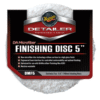


A full paint correction sequence has a beginning and an end. The beginning is the cutting phase — removing defects. The end is the finishing phase — removing the haze, micro-marring, and fine swirls left by the cutting disc so the paint looks as clear and reflective as possible before wax or coating goes on. The microfiber finishing disc is what does that final refinement in tight areas where a 6-inch finishing disc cannot operate.
The DA Microfiber Finishing Disc 5″ (2-Pack) is designed specifically for the finishing phase of DA correction on small panel sections, pillar work, and tight curved areas. The microfiber finishing face is less aggressive than a cutting disc — it refines rather than removes — producing a glossy, haze-free surface that is ready for inspection and protection application. The 2-pack format is the right quantity for mobile detailers and shops using the 5-inch finishing disc as a complement to their primary 6-inch system.
What DA Microfiber Finishing Discs Are
Microfiber finishing discs are the final-stage pad in a DA correction sequence. They are less aggressive than microfiber cutting discs — the finishing face refines the micro-level haze and fine scratches left by cutting work rather than removing deep defects. On a DA polisher, the combination of the machine’s random orbit and the microfiber finishing face produces a level of surface refinement that prepares paint for coating application. These discs are the 5-inch version, designed for tight sections.
Key Features and Why They Matter
- Microfiber finishing face — refines haze and micro-marring more effectively than foam finishing pads on DA machines. So what? Produces a higher-clarity base surface for wax, sealant, or ceramic coating than a standard foam finishing pad in the same number of passes.
- 5-inch diameter — access to tight sections, pillars, and areas where 6-inch discs cannot maneuver cleanly. Matches the working size of the 5-inch cutting disc system for a complete tight-area correction and finishing workflow.
- 2-pack format — two fresh discs. Use one while the other dries after cleaning, or keep a fresh disc ready for the next job.
- Hook-and-loop backing — attaches to standard 5-inch DA backing plates. Compatible with the same plate used for the 5-inch cutting disc.
- Pairs with finishing polish — works with finishing polishes and light glazes. Not intended for use with heavy cutting compounds.
What These Are NOT For
Microfiber finishing discs are not cutting discs — they will not remove deep swirls, heavy oxidation, or sanding marks. For defect removal, use a microfiber cutting disc first. The finishing disc is the second step, after cutting is complete. Do not use on matte or satin finishes. For large-panel finishing work, the 6-inch microfiber finishing disc covers ground more efficiently.
Who Uses These
Detailers running a complete DA microfiber correction system who need a 5-inch finishing disc to match their 5-inch cutting disc workflow on tight sections, shops finishing correction work on pillars and small panels, and mobile detailers who want to complete the full correction sequence on tight-area sections without switching to a separate finishing system.
How to Use
- Complete cutting phase first — run a microfiber cutting disc and cutting compound on defected sections before switching to finishing.
- Apply finishing polish to the finishing disc — a small amount, about the size of a dime. Microfiber holds product efficiently.
- Run at low to medium DA speed (speed 3–4) for finishing work. Lower speed, lighter pressure.
- Work in overlapping passes across the section until haze clears and gloss develops.
- Wipe the surface with a clean microfiber to inspect. If haze remains, repeat one more pass before moving to protection.
- Clean the disc after each use — rinse under warm water, air dry flat.
Frequently Asked Questions
Do I need both 5-inch and 6-inch finishing discs?
If your full-vehicle correction workflow uses both 5-inch and 6-inch cutting discs, you should have both finishing disc sizes to complete the correction sequence on all sections. A tight pillar that was cut with a 5-inch cutting disc should be finished with a 5-inch finishing disc for consistent results. The 6-inch finishing disc handles main panels, while the 5-inch handles tight sections.
What finishing polish works best with microfiber finishing discs?
Light finishing polishes and glazes formulated for machine application work well. Avoid heavy compounds on finishing discs — they are not designed to cut at that level and the result will be uneven. Products labeled for finishing or jeweling step application are the right category.
Can I use the finishing disc without a prior cutting step?
Yes — on paint that is in good condition without deep defects, the microfiber finishing disc can be used alone for haze removal, gloss enhancement, and pre-coating surface refinement. It is only when actual defect removal is needed that a cutting disc is required first.
How do I clean these finishing discs?
Rinse under warm running water while gently working polish residue out of the microfiber face. Air dry flat. No machine washing or fabric softener — both permanently damage microfiber performance.
How is a microfiber finishing disc different from a foam white finishing pad?
Microfiber finishing discs typically produce higher surface clarity than foam white pads at the same machine speed, because the microfiber face engages with the polish and paint surface at a finer level. The trade-off is that microfiber discs require more careful cleaning and more frequent replacement than foam pads. For shops that prioritize correction quality over pad longevity, the microfiber system is the preferred approach.