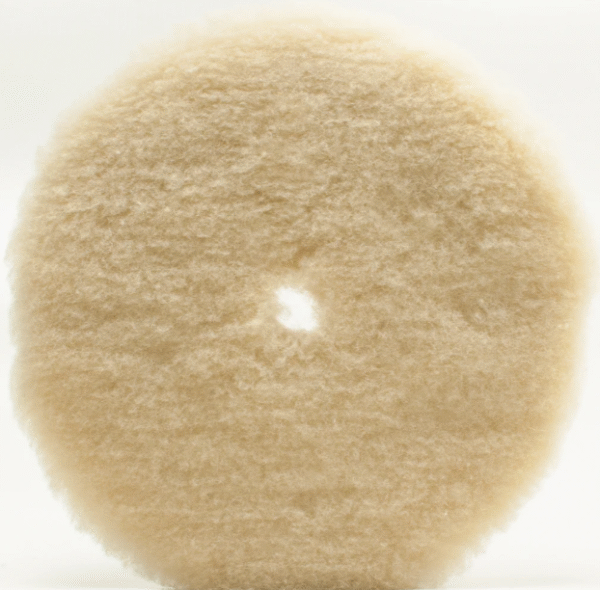
Production correction shops know the pad economics: premium cutting pads cost $20-30 per unit, and a busy shop goes through four to eight per shift on heavy correction days. That per-pad cost accumulates quickly at weekly scale. The BS Uro-Wool 100% Knitted Wool Cutting Pad is built for exactly this operational reality — professional-grade knitted wool cutting performance in a shop-supply format that keeps pad costs in line without sacrificing the aggressive cut required for genuine heavy correction work.
BS Uro-Wool 100% Knitted Wool Cutting Pad from Polishing Systems Inc is a hook-and-loop backed cutting pad compatible with standard 5/8″-11 or metric backing plates on rotary and dual-action polishers. Knitted wool construction provides the aggressive, consistent abrasion needed for severe oxidation, heavy swirl patterns, sanding mark removal, and defects that foam cutting pads cannot efficiently address.
What This Pad Is
This is a wool cutting pad — the most aggressive pad category in the correction lineup. Wool cuts faster than any foam because individual fibers act as flexible abrading elements that fracture and renew their cutting edge during use. Knitted wool specifically maintains more dimensional stability than twisted or woven alternatives, producing consistent pressure distribution across the pad face throughout the correction pass. This is the pad used before stepping down to a foam polishing sequence.
Key Features and Why They Matter
- 100% knitted wool face — maximum cutting efficiency on heavy defects, oxidized gel coat, and 1500-grit or coarser sanding marks. Cuts faster than foam cutting pads per panel, directly reducing labor hours on severe correction jobs.
- Knitted construction resists matting — maintains fiber loft under sustained machine use better than twisted or random-fiber alternatives. Consistent cut rate throughout the panel pass, not just the first few seconds.
- Hook-and-loop backing — compatible with 5/8″-11 and metric backing plates on Porter-Cable, Rupes, Flex, Griot’s, Milwaukee, and most professional polisher platforms.
- Shop-supply value pricing — designed for high-volume shop use where pads are consumables. Enables correction-level performance across a full fleet day without premium-pad cost constraints.
- Machine-washable for repeated use cycles — reduces per-job pad cost further when cleaning discipline is maintained.
What This Pad Is NOT For
Wool cutting pads are not finishing pads. This pad will leave wool haze and a flat, non-glossy surface — normal and expected. A proper correction sequence requires stepping down to a foam polishing pad with medium or finishing polish after the wool cut step to remove wool haze and develop gloss. Do not attempt to finish directly off a wool pad. Not recommended for soft single-stage paints on a rotary without testing — wool cuts through thin single-stage paint quickly under a rotary at high RPM.
Who Uses This Pad
Production correction shops, fleet reconditioning operations, body shops doing pre-respray paint prep, marine gel coat restoration specialists, and RV paint correction crews are the primary users. Any operation running more than five heavy correction jobs per week will find the shop-supply format and pricing of the BS Uro-Wool pad financially meaningful. Enthusiast detailers doing occasional heavy correction on project cars also benefit from the aggressive cut of knitted wool versus foam cutting pads.
How to Use
- Pair with a heavy-cut compound. Prime the pad with 3-4 pea-sized product drops spread across the face before starting.
- Set polisher speed — rotary: 1,200-1,800 RPM. DA (forced rotation or 15mm+ orbit): medium-high speed setting.
- Work in 2×2-foot sections. Spread compound at light first pass, then apply working pressure for correction passes.
- Inspect after 3-4 passes — wipe residue with a clean microfiber and check defect removal under proper lighting.
- Step down to foam polishing sequence after cutting is complete to remove wool haze and develop gloss.
- Clean the pad with a pad brush after each panel or when product loading becomes visible.
Why Buy This vs. Big-Box Import Wool Pads
Consumer-grade import wool pads often use blended wool (mixed with synthetic fiber) that cuts inconsistently and mats quickly under machine use. The BS Uro-Wool pad uses 100% knitted wool construction that maintains fiber integrity and consistent cut rate across multiple jobs. For professional correction workflows, pad consistency is not optional — an inconsistent pad creates variable cut rates that require rework passes, defeating the labor savings you were trying to achieve.
Frequently Asked Questions
Can I use this pad on a random orbit DA polisher?
Yes, but wool pads perform best on forced-rotation DA polishers (Rupes Bigfoot series, Flex XFE) or rotary polishers. On standard random orbit DA machines, the mass of the wool pad may stall the orbit under pressure, reducing cutting efficiency. Test on a panel section before committing to a full correction sequence on a random orbit DA.
How do I clean this pad between uses?
During use, clear product loading with a firm pad brush at low machine speed. After the job, machine wash in a mesh laundry bag with a pad-safe cleaner — cold water, gentle cycle. Air dry completely before reuse. Do not machine dry; heat will shrink and distort the foam-velcro backing interface.
How many correction jobs will one pad last?
A well-maintained BS Uro-Wool pad used on standard automotive correction typically provides 15-30 panel-section uses before cutting efficiency noticeably declines. Replace when fibers mat and do not recover after cleaning.
Is this compatible with Rupes backing plates?
Yes — the standard hook-and-loop backing is compatible with Rupes, Flex, Porter-Cable, Griot’s, Milwaukee, DeWalt, and virtually all professional polisher backing plates using standard hook-and-loop fastening.
Do I need a different pad for gel coat vs. automotive paint?
The same knitted wool pad works on both. Gel coat is generally harder than automotive clear coat and tolerates the aggressive cut of wool well — use a gel coat-appropriate compound. For thin automotive single-stage paint, test first; wool on a rotary at high speed can cut through quickly, especially on factory paints with thin film builds.