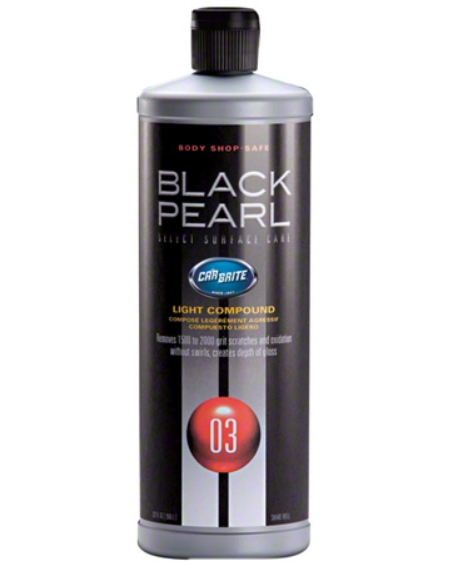
The majority of vehicles that come through a professional detail operation are not heavily defected correction candidates — they are daily drivers with a year or two of car wash swirling, light water spotting, and minor clear coat haze that needs addressing efficiently without the time investment of a full three-stage correction sequence. The light compound is the product that makes those jobs economically viable: enough cut to address the defects present, enough refinement capability to skip the intermediate polishing stage on most paint systems.
Black Pearl Light Compound 32 oz (SKU CBOOBP03-02) is the fine-cut option in the Black Pearl correction lineup — less aggressive than the heavy and medium compounds, more cutting ability than a dedicated finishing polish. The diminishing abrasive technology allows it to remove light swirling and water spots while simultaneously refining the surface, reducing the total number of correction stages needed for lightly defected paint. The 32-oz size is the professional working volume for shops using this as their primary correction product for the majority of their daily detailing work.
What This Product Is
Black Pearl Light Compound is a fine-cut, diminishing-abrasive correction compound for light to moderate paint defects. It is positioned between a finishing polish and a medium compound — more correction ability than a finishing polish, less aggressive than medium or heavy compound. Suitable for one-step correction on lightly to moderately swirled daily-driver paint, and as the intermediate refining step between heavy compound and final finish in a complete multi-stage correction sequence.
Key Features and Why They Matter
- Light-cut compound abrasive level — enough cut for light swirl removal and water spot correction with a single pass, without the aggressive cutting that requires additional polish stages to refine.
- Diminishing abrasive technology — refines as it cuts. The abrasive particles break down during the polishing pass, leaving a smoother surface finish than a fixed-abrasive product of equivalent initial cut rate.
- One-step capability on lightly defected paint — on daily-driver vehicles with light swirling, light compound can correct and refine in a single correction stage, allowing a direct transition to finishing polish or LSP application.
- Works on rotary and DA — appropriate for both machine types. On DA with medium foam, works as a comprehensive one-step. On rotary with a softer foam, can produce a near-final finish in fewer total machine steps.
What This Is NOT For
Black Pearl Light Compound will not efficiently remove deep sanding marks, heavy oxidation, or significant paint defects that require the cut rate of the Medium or Heavy Compound. Using light compound on a surface that needs heavy correction means running the machine significantly longer for the same result — match the product to the defect level for production efficiency. Not appropriate for severe marine gel coat oxidation or deep paint damage.
Who Uses This
Mobile detailers doing one-step correction enhancement on the majority of their daily-driver customers use light compound as their primary correction product — it handles the light-swirl correction that constitutes most of their work in a single efficient stage. Detail shops processing steady customer volume where deep correction is the exception rather than the rule use light compound for the standard paint enhancement service with final finish as the polish stage. As part of the Black Pearl system, it serves as the intermediate refining step after heavy or medium compound work. Pair with the Black Pearl Final Finish for a two-stage correction and finishing workflow.
How to Use
- Select pad: A yellow or medium-density foam pad on DA, or a polishing foam on rotary. Light compound does not require an aggressive cutting pad.
- Apply: 3–4 pea-sized drops on the pad. Spread at low speed before correction passes.
- Set speed: DA polisher: setting 3–5. Rotary: 1,000–1,400 RPM.
- Work sections: 2–3 square feet per section. Work until compound becomes clear.
- Inspect: Light swirling should be removed or significantly reduced after a single correction pass. Repeat for stubborn areas or step up to medium compound if the defect level exceeds what light compound can address efficiently.
- Follow up: Apply Final Finish for maximum gloss, or proceed directly to LSP if correction result meets the target standard.
Frequently Asked Questions
Is light compound the same as a finishing polish?
No — light compound has more abrasive cut than a finishing polish. A finishing polish like Black Pearl Final Finish is used after all defect removal work is complete; it removes micro-marring and refines to maximum gloss without significant defect correction. Light compound actively removes light defects while also refining — it bridges the gap between correcting and finishing.
Can I use light compound on dark-colored vehicles?
Yes — light compound with a medium foam pad on a DA polisher is one of the most-used combinations for single-stage correction on dark-colored daily-driver vehicles. Dark paint shows swirling most visibly, and light compound addresses that swirling without introducing correction artifacts that require significant finishing work to resolve.
What is the difference between Black Pearl Light and Medium Compound?
The Medium Compound has a higher abrasive concentration and cut rate — it removes more severe defects faster but requires more finishing work afterward. Light Compound has lower abrasive concentration — appropriate for lighter defects, one-step correction, and intermediate refining in a multi-stage system. The cut rate difference is meaningful in production work: use the least aggressive product that makes efficient progress on the defect level present.
How many vehicles can I correct with 32 oz of light compound?
At typical application rates on a standard passenger vehicle with moderate defect coverage, 32 oz of light compound covers 15–25 complete single-stage correction sessions depending on vehicle size, defect coverage, and application technique. Heavier application or larger vehicles reduce yield; efficient application technique on focused defect areas extends it.
Does light compound work for water spot removal?
Yes — light compound removes light to moderate water spots (mineral deposits that etch the surface rather than bonding into the clear coat). For very deep, etched water spots that have bonded into the clear coat, medium or heavy compound may be needed for complete removal. Inspect the severity before choosing the starting compound level.