In a professional paint preparation sequence, P800 is the working grit that bridges the mid-cut surface work (320-400) and the fine finish-prep (1200) steps. It removes the visible scratch marks left by coarser grits and levels any primer irregularities — guide coat pinholes, light runs, surface texture from spray — into a surface smooth enough that P1200 or finer can take it to paint-ready in a single step. Skipping the P800 step forces P1200 to do more work than it is designed for, which means either more passes at P1200 or visible scratch-show under color.
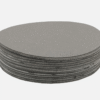
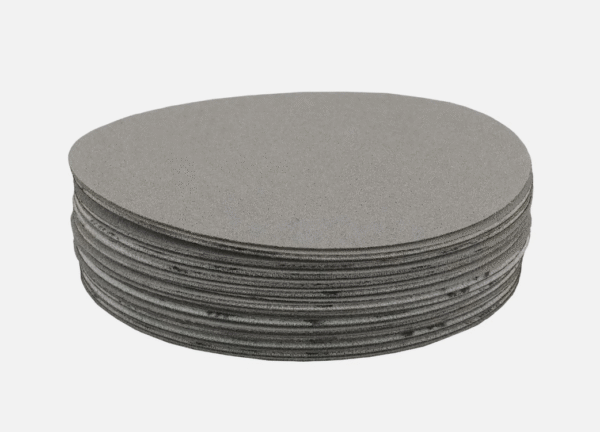
6″ Film Grip Sanding Discs — P800, 100/Box from Polishing Systems Inc is the P800 intermediate-prep disc in film-backed, hook-and-loop format at production-quantity 100-disc box pricing. The film backing provides the wet-sanding performance and dimensional stability needed for consistent results in body shop and paint prep production environments.
What These Discs Are
6-inch hook-and-loop film-backed sanding discs in P800 grit (approximately 800 grit). The film (polyester) substrate provides consistent disc geometry and wet-sanding durability. Hook-and-loop back for 6-inch sanding backing pads. One hundred discs per box for shop-scale consumption. P800 is a fine-grit disc appropriate for primer sanding, guide coat removal, and intermediate scratch refinement in a body shop grit progression.
Key Features and Why They Matter
- P800 intermediate grit — the bridge between cut grits and finish-prep grits. Removes P320-P400 scratch marks and levels primer irregularities without the aggressive material removal of coarser grits.
- Film backing for wet sanding — maintains disc geometry under wet conditions. Does not soften, swell, or tear under sanding lubrication the way paper-backed discs can during extended wet sanding sessions.
- 100 discs per box — production quantity for shops running multiple vehicles through prep simultaneously. The economics at 100-count are appropriate for daily production use.
- Consistent abrasive distribution — film substrate maintains flat, consistent abrasive face geometry for even cutting across the panel surface.
- Hook-and-loop compatibility — attaches to any standard 6-inch hook-and-loop backing pad on orbital, DA, or straight-line sanders.
Who Uses P800 Discs
Body shop paint prep technicians sanding primer surfaces in a multi-grit sequence. Painters sanding between coats and addressing surface defects in primer layers. Detail shops doing light surface wet sanding for paint correction preparation. For the coarser prep grits, see the 320 Grit Frip Disc. For the fine finish-prep step after P800, the P1200 Film Grip Disc is the next grit in the professional sequence. For the small-format 3-inch equivalent discs for spot work, see the 3-inch film grip sanding disc options.
How to Use
- Attach the P800 disc to a 6-inch hook-and-loop backing pad.
- For primer sanding, apply guide coat (light contrasting paint coat) to reveal high and low spots before sanding — the guide coat sands away from high spots first, revealing areas that need more work.
- Sand with consistent, overlapping passes in a systematic pattern across the surface. Check guide coat removal regularly to monitor surface level.
- For wet sanding applications, apply soapy water or dedicated sanding lubricant to the surface before and during sanding.
- Clean the surface and inspect under proper lighting before progressing to P1200.
Frequently Asked Questions
What grit comes before P800 in a standard body shop sequence?
A typical production body shop sequence for panel preparation starts at P80-P120 for body filler shaping, progresses to P180-P220 for filler refining, P320-P400 for primer prep and primer sanding, then P800 for intermediate leveling before P1200 or P1500 for final finish prep. The specific grits used depend on the paint system, the filler type, and the quality level of the final finish required.
Can P800 be used on bare metal?
P800 is fine enough for bare metal sanding in specific applications — scuff sanding before primer application, for example, or preparing bare aluminum for adhesion bonding. For featheredging bare metal repairs, coarser grits (P80-P120) are more appropriate for initial material removal before progressing through the grit sequence. Check with your primer manufacturer for the coarsest acceptable sanding grit for direct-to-metal primer adhesion in your specific system.
Is the “Film Grip” designation different from “Film Frip”?
Film Grip and Film Frip refer to two specific product series within the film-backed sanding disc range. Both use a polyester film backing but may differ in abrasive type, coating, or intended use application. The P800 Film Grip disc is optimized for the intermediate paint prep application described, while the Film Frip series covers different grit range and application specifications. Both are professional-grade film-backed discs for production body shop use.
How do I prevent the disc from loading with primer material?
Prevent disc loading by: (1) using the correct grit — trying to sand too aggressively with too fine a grit loads the disc faster; (2) not applying too much pressure — let the machine and abrasive do the work; (3) sanding wet where appropriate — lubricant prevents primer material from bonding to the abrasive; and (4) changing discs regularly — a slightly loaded disc is far less efficient than a fresh disc.