
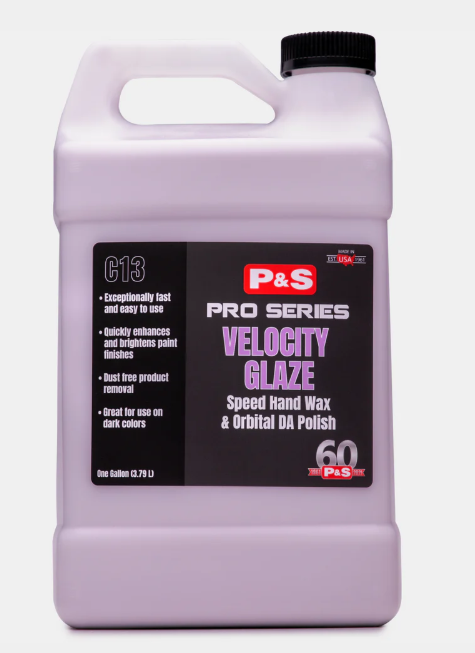
Finishing glazes occupy a specific position in the paint correction sequence: after compounding and polishing have removed defects and leveled the clear coat, the glaze step is where color depth and gloss are maximized before the protection step — wax, sealant, or ceramic coating. It is not a correction product. It is an optical enhancement product. The difference between a corrected vehicle with and without a finishing glaze step is the difference between paint that looks clean and paint that looks wet.
Velocity Glaze is a finishing glaze formulated to deepen paint color, fill micro-fine surface texture left by polishing, and produce a wet, reflective finish before the protection layer. The formula is compatible with rotary, DA, or hand application and works on automotive paint, marine gel coat, and clearcoated surfaces.
What Velocity Glaze Is
Velocity Glaze is a finishing glaze — not a polish, not a compound, not a wax. It contains fine optical fillers that temporarily fill micro-texture in the clear coat surface to produce a higher perceived gloss, combined with color-deepening agents that enhance paint depth and saturation under light. It is applied as the last step before the protection product in a multi-step paint finishing sequence. The formula strips cleanly without leaving residue that interferes with sealant or wax bonding.
Key Features and Why They Matter
- Color depth enhancement — optical compounds deepen paint color saturation, particularly on dark and jewel-tone colors where depth is the primary measure of a quality finish.
- Micro-fill technology — fine optical fillers fill the micro-texture left by polishing for a smoother, more reflective surface before the protection step. The result is a wet, mirror-like reflection vs. a flat-polished appearance.
- Pre-protection compatibility — designed to be used before wax, paint sealant, or ceramic coating without leaving a residue that prevents bonding.
- Machine or hand application — compatible with finishing foam pads on rotary or DA polishers, or hand application with a soft foam applicator for smaller areas and touch-up work.
What This Is NOT For
Velocity Glaze is a finishing product and does not remove paint defects — scratches, swirl marks, and oxidation must be addressed with compound and polish before glaze application. Do not apply ceramic coatings over glaze without confirming the specific coating manufacturer’s requirements — some coatings require an IPA wipe-down to remove all fillers before application. Do not use on matte or satin finishes.
Who Uses Velocity Glaze
Detail shops that deliver a full paint correction result (compound, polish, glaze, protect) as their premium service use Velocity Glaze to differentiate their finished result. Show car preparation consistently includes a glaze step before show wax because the optical result under show lighting is measurably better. Mobile detailers include glaze in their top-tier detail package as a visible result differentiator. Dealerships use it on new car delivery prep where maximum gloss is the deliverable.
How to Use
- Complete compounding and polishing steps first. Velocity Glaze is applied to already-corrected paint.
- Apply a small amount to a clean finishing foam pad or soft foam hand applicator.
- Work in one panel at a time — spread at low speed and increase to finishing speed. Keep the pad moving to distribute the glaze evenly.
- Allow brief flash time — 1–2 minutes for the glaze to begin setting before buffing.
- Buff off with a clean, high-nap microfiber towel using light, straight-line passes. The surface should immediately show a deep, wet-gloss appearance.
- Apply protection product — wax, sealant, or ceramic coating — over the glazed surface within the window specified by your protection product’s instructions.
Frequently Asked Questions
Does glaze interfere with ceramic coating application?
Traditional optical-filler glazes can interfere with ceramic coating bonding if not fully removed before application. If using Velocity Glaze before a ceramic coating, perform a panel wipe with isopropyl alcohol (70% or higher) after buffing the glaze to remove filler residue before coating application. This is standard practice for any nano-coating prep.
How is a glaze different from a paint sealant or wax?
Glaze is an optical enhancement product — it improves how paint looks but provides minimal protection on its own. Wax and paint sealants provide protection (hydrophobic behavior, UV resistance, physical barrier) with some gloss contribution. Glaze is applied before the protection product to maximize the optical result under the protection layer.
Can I use Velocity Glaze on matte or satin finishes?
No — gloss-enhancing glazes alter the sheen of matte and satin finishes. Use only products specifically formulated for matte surfaces on flat finish paint or vinyl wraps.
How long does the glaze effect last?
The optical fill effect diminishes with each wash cycle as the fine fillers are removed — typically 4–8 weeks of regular washing. Regular reapplication as part of a maintenance detail cycle keeps paint looking consistently finished.
What other paint finishing products does Polishing Systems Inc carry?
We carry compounds, polishes, finishing glazes, carnauba waxes, paint sealants, and ceramic coatings for the complete paint finishing sequence. Browse the exterior paint correction and protection lineup for the full range.