Not every paint correction job happens on a flat door panel. Pillars, mirror backs, fender edges, and quarter panel transitions all require correction — and running a 6-inch or 7-inch cutting pad into those areas risks edge strikes that leave permanent marks on adjacent panel sections. Smaller cutting pads exist precisely for this scenario: the same wool cutting chemistry and aggression, in a size that fits the workspace.
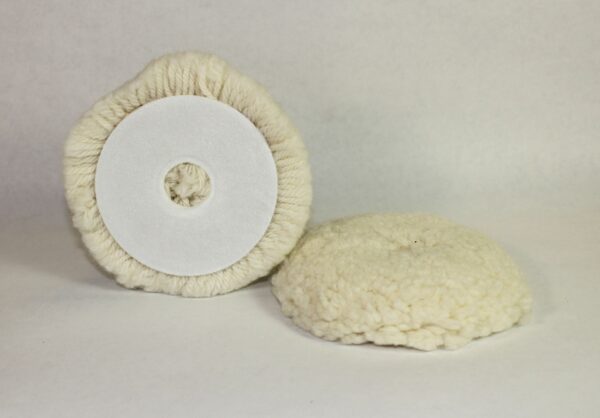
The 4″ Velcro Wool Buffing Pad delivers aggressive compounding capability in a 4-inch format that fits tight body areas and provides better control in confined spaces than larger pad formats. The hook-and-loop backing connects directly to standard 3-inch to 4-inch backing plates for use on DA or rotary polishers.
What This Product Is
This is a 4-inch diameter wool cutting pad with hook-and-loop backing plate attachment. The wool face is designed for aggressive compounding — removing deep swirls, oxidation, and paint defects — in a compact size that provides better control in tight body areas than 6-inch and 7-inch pads. The 4-inch size is standard in spot correction and small-panel work workflows.
Key Features and Why They Matter
- 4-inch compact size — fits areas where larger pads cannot work without edge strikes. Pillars, door jambs, edges, and tight body contours become manageable correction targets rather than areas to work around.
- Wool cutting face — delivers the aggressive cut rate wool is known for in paint defect removal. Faster defect clearing than comparably-sized foam cutting pads on hard or severely oxidized paint.
- Hook-and-loop backing — the Velcro-style connection to backing plates. Swaps on and off a 3-inch or 4-inch backing plate in seconds without tools, allowing quick pad changes between correction and polishing steps.
- Durable wool construction — washable and reusable across multiple correction sessions with proper cleaning and maintenance.
What This Is NOT For
The 4-inch wool cutting pad leaves a cut finish that requires follow-up with a foam polishing pad and medium or finishing polish. Do not use as a finishing pad. Do not use on single-stage paint without controlling speed and dwell carefully. Not for glass surfaces. Always follow wool compounding with the appropriate foam polishing sequence before final inspection.
Who Uses This
Body shop technicians doing spot-panel paint correction after sanding use the 4-inch format to work panel edges and tight areas that a larger pad cannot reach. Professional detailers doing full-vehicle correction use it for areas where their primary pad size is too large. Mobile detailers who work on tight sports car body lines find the 4-inch format indispensable for complete panel coverage.
How to Use
- Attach to a 3-inch or 4-inch hook-and-loop backing plate on your DA or rotary polisher. Center the pad on the backing plate.
- Apply compound to the pad face — for a 4-inch pad, 3–4 pea-sized dots spread across the face is appropriate. Prime at low speed before engaging correction speed.
- Set speed based on paint hardness and defect depth. Monitor surface temperature.
- Work in 12-inch to 18-inch sections — overlap passes by 50%. The compact pad covers less area per pass, so work deliberately.
- Clean the pad frequently — blow out compound loading with compressed air between sections.
- Follow with foam polishing to remove the cut marks before inspection and protection steps.
Why Buy This vs. Working Around Tight Areas with a Larger Pad
A detailer who attempts to correct a pillar or mirror back with a 6-inch cutting pad either leaves those areas undercorrected or creates edge strikes on adjacent panels that require additional work. The 4-inch format closes that gap — every correctable area gets corrected properly. The cost of a complete pad kit that includes the 4-inch cutting size pays for itself in the first job where it prevents a callback or rework. See the full polishing pad selection for the complete size range.
Frequently Asked Questions
What backing plate size does this work with?
The 4-inch wool buffing pad is designed for use with 3-inch to 4-inch hook-and-loop backing plates. Using a backing plate that is too large or too small reduces pad flex and creates uneven pressure distribution across the wool face.
Can I use this on a random orbital (DA) polisher?
Yes — compatible with DA polishers using a 3-inch or 4-inch backing plate. A high-powered forced-rotation DA extracts more wool cutting efficiency than a free-rotation DA at equivalent settings. For maximum cutting action, a rotary or forced-rotation DA is preferred.
How do I clean a wool pad after compounding?
After each use, blow out compound residue with compressed air. For deep cleaning, hand-wash in warm water with a mild pad cleaning solution. Allow to dry flat away from heat before storage or reuse. Do not machine-wash with hot water, which mats wool fibers.
How many correction sessions can I get from one pad?
With proper cleaning and maintenance after each use, professional wool pads provide many correction sessions before fiber fatigue reduces their cut efficiency. Signs of end-of-life include matted fiber that does not restore after cleaning or uneven cut performance across the pad face.
What compound should I pair with this pad?
Match the compound to the defect severity and paint hardness — heavy-cut for oxidation and sanding marks, medium compound for deep swirls on hard paint. Browse compounds and polishes for compatible products.