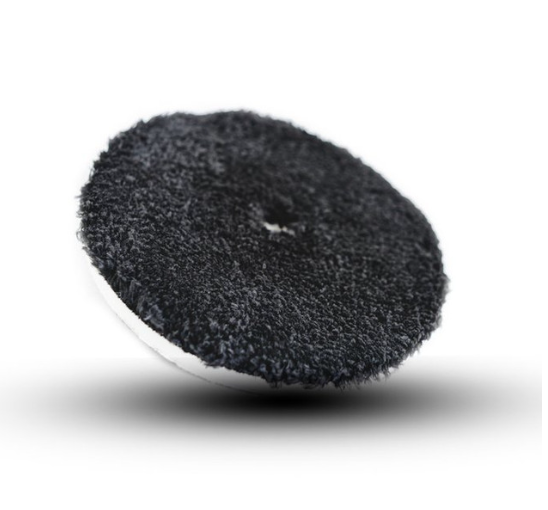
Heavy defect removal — deep swirls, oxidation, 1200-grit sanding marks, and gel coat etching — requires a pad that cuts aggressively without glazing over or losing its face geometry after the first panel. Foam pads work in many correction scenarios, but for truly heavy correction work, especially on hard paint systems, gel coat, and severely oxidized finishes, wool is the correct material. Wool fibers cut mechanically, generate less heat per unit of correction than foam at equivalent pressure, and resist glazing at the speeds required for production-shop compounding.
Uro Wool knitted cutting pads from Polishing Systems Inc are professional-grade wool compounding pads designed for rotary and high-powered DA polisher use. The knitted wool construction maintains consistent fiber height and cutting geometry across the face of the pad, delivering repeatable performance from the first pass through the last vehicle of the shift.
What Uro Wool Cutting Pads Are
These are knitted wool cutting pads built for machine application with compounds and heavy polishes on automotive paint, marine gel coat, and clearcoated surfaces requiring significant defect removal. Knitted wool construction — distinct from woven wool — provides a consistent, open pile that resists clogging with compound residue and cleans out easily between passes. They are not finishing pads; they are the aggressive first step in a multi-stage paint correction sequence.
Key Features and Why They Matter
- Knitted wool construction — knitted pile maintains a consistent, open face geometry that cuts predictably and resists clogging. Cuts consistently across a full correction session.
- Aggressive cut rate — removes deep swirl marks, oxidation, and light sanding scratches more quickly than foam cutting pads at equivalent polisher settings. Reduces passes required on heavy-condition paint.
- Heat management — wool’s fiber geometry distributes friction differently than closed-cell foam, producing effective cut with less localized heat buildup at equivalent pressure.
- Durable and washable — professional wool pads are designed to be washed, conditioned, and reused across multiple correction sessions.
- Hook-and-loop backing — connects to standard backing plates on rotary and DA polishers for direct use in existing polishing setups.
What This Is NOT For
Wool cutting pads are not for final polishing or finishing steps. They leave a cut finish that requires follow-up with a medium or finishing foam pad and polish to remove. Do not use on single-stage paints without controlling speed and pressure carefully — single-stage paint is soft and marks easily with aggressive wool at high speeds. Do not use on vehicle glass. Always follow a wool compounding pass with foam polishing to complete the correction sequence.
Who Uses Uro Wool Pads
Production paint correction shops handling heavy-oxidation fleet vehicles, marine reconditioning facilities working on gel coat, body shops doing post-sanding paint finishing, and experienced mobile detailers correcting severely defective paint are the core buyers. These are professional-grade pads that deliver the fastest correction times in the right hands but require proper technique and compound selection.
How to Use
- Pair with the right compound — use with a heavy-cut or medium-cut compound appropriate for the defect level and paint hardness.
- Prime the pad — apply a small amount of compound to the pad face and spread at low speed before engaging correction speed. Never run a dry wool pad at speed on paint.
- Set polisher speed — start at medium speed (1,200–1,500 OPM on a DA; 800–1,200 RPM on a rotary) and adjust based on cut result. Monitor panel temperature.
- Work in 2-foot sections — overlap passes by 50%. Keep the pad moving — never stop on the paint with the machine running at correction speed.
- Clean the pad frequently — blow out compound loading with compressed air between sections to maintain consistent cut.
- Follow with foam polishing — remove the cut marks left by the wool pad with a medium foam pad and finishing polish before inspection.
Why Buy Professional Wool Pads vs. Retail Buffing Pads
Consumer-grade wool pads from hardware stores are typically woven wool bonnets designed for drill attachment — they do not fit professional backing plates, they cut inconsistently, and they cannot be maintained across multiple sessions. Professional knitted wool pads like the Uro Wool line are engineered for professional polishers, deliver consistent cut geometry, and are designed to be washed and reused as a production shop asset. For the foam polishing pads needed after the wool compounding step, see the full polishing pad selection.
Frequently Asked Questions
Can I use a wool cutting pad on a dual-action orbital polisher?
Yes — knitted wool cutting pads are compatible with high-powered forced-rotation DA polishers (Rupes LHR21, Flex XFE 7-15, and similar machines). On standard free-rotation DA polishers at low RPM, wool pads may not generate sufficient cutting action. A rotary polisher extracts maximum efficiency from wool cutting pads.
How do I clean and maintain wool cutting pads?
After each use, blow out compound residue with compressed air. Deep-clean by hand-washing in warm water with a mild pad cleaning detergent — do not machine wash with hot water or harsh detergents, which mat the wool fibers. Allow to dry flat away from direct heat before storage.
What backing plate size do I need?
Match the backing plate to the pad diameter, leaving approximately 1/2″ to 1″ of pad overhang around the plate edge. Confirm backing plate compatibility with your specific polisher spindle thread before ordering.
Will this pad work on marine gel coat?
Yes — knitted wool cutting pads are widely used for gel coat compounding on boats, RVs, and fiberglass surfaces. Gel coat is typically harder and more oxidation-prone than automotive clear coat, making wool’s aggressive cut well-suited. Follow with foam polishing and finishing wax for a complete marine correction sequence.
What other polishing pads does Polishing Systems Inc carry?
We carry a full range of professional polishing pads including cutting foam, polishing foam, and finishing foam pads in multiple sizes for all correction stages. Browse the exterior polishing pad selection for the full lineup.