
The pad choice in the middle of a paint correction sequence is where detailers make or break their workflow. Too aggressive, and you are creating work for the finishing step that did not need to exist. Too soft, and you are spinning the polisher on a swirl pattern that is not moving. The medium-cut pad is the balance point — enough foam density to work a medium polish effectively and address the swirls and haze left by the cutting step, without the foam hardness that drags heat into the paint unnecessarily.
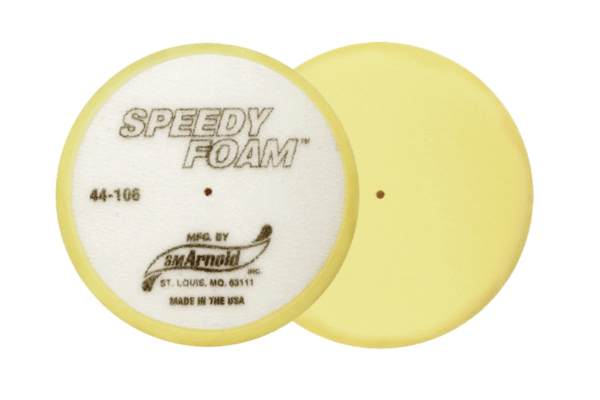
The 6″ Speedy Foam Buffing Pad from Polishing Systems Inc hits that medium-cut balance point for standard automotive and marine correction work. Medium-density foam, compatible with both DA and rotary polishers, and sized for the 6-inch backing plate that is the standard setup for single-panel paint correction on most professional detailing machines.
What This Pad Is
A 6-inch medium-density foam buffing pad with hook-and-loop backing for machine polisher attachment. Designed for medium-cut compound and medium polish application in the middle step of a paint correction process. Compatible with DA and rotary polishers on standard 5-inch to 6-inch backing plates. Not a heavy-cut compound pad and not a soft finishing pad — positioned squarely at the medium-cut step.
Key Features and Why They Matter
- Medium foam density — the correct density for medium-cut work: enough resistance to work the compound effectively without the heat generation of a stiff cutting pad, enough softness to produce a surface that the finishing step can quickly bring to final gloss.
- 6-inch diameter — standard machine polisher pad size for the professional 6-inch backing plate setup. Covers open panel sections efficiently at working speed.
- Hook-and-loop backing — standard attachment system compatible with the vast majority of professional DA and rotary polisher backing plates.
- Speedy foam construction — cell structure designed for consistent product release and pickup during machine polishing passes.
What This Pad Is NOT For
Not a heavy-cut pad — for removing 1500-grit sanding marks, severe oxidation, or deep scratches, a firmer compound pad is needed. Not a finishing pad — the medium density will leave some haze that requires a finishing step with a soft pad and finishing polish to resolve. For a complete correction system, this pad fits between the cutting pad and finishing pad in the sequence. For pad and compound pairing guidance, see the compounds and polishes category.
Who Uses This
Professional detailers who do two-step or three-step paint correction processes on automotive, marine, and RV surfaces. Body shop refinishers who cut and buff clearcoat to final gloss. Mobile detailers who include swirl removal and paint correction in their service lineup. Enthusiasts who machine-polish their own vehicles and need the correct pad for the swirl removal step in a multi-pass correction process.
How to Use
- Prime the pad: Apply 3-5 pea-sized drops of medium polish to the pad face. Spread at low speed before increasing to working speed.
- Work at medium speed: Typically speed 3-4 on a DA polisher (2,500–3,500 OPM). High enough to work the compound effectively, low enough to avoid excess heat generation.
- Work in overlapping sections: 18×18-inch sections with 50% overlap. Consistent overlapping passes ensure uniform defect removal across the panel.
- Wipe and inspect: Wipe with a clean microfiber after each section. Inspect under a panel light before moving to the next section — the goal is removing swirls and haze left by the cutting step, not adding new defects.
- Clean the pad: Clean with a pad conditioning brush or rinse during the session to prevent compound loading from reducing cut effectiveness.
Why Use This Pad vs. Finishing Everything with a Soft Pad
Skipping the medium-cut step and trying to finish directly from a cutting compound to a finishing pad leaves an intermediate layer of haze and marring that the finishing pad cannot remove effectively. The medium-cut step resolves the defects left by aggressive compound work before the finishing pad produces the final gloss. For the full paint correction system — from heavy-cut compound through finishing polish — see the exterior buffing pad lineup at Polishing Systems Inc.
Frequently Asked Questions
What polish should I pair with this pad?
A medium polish or all-in-one compound/polish is the typical pairing for a medium-density foam pad. On very hard paints (some European finishes and urethane-based single-stage), a light-cut compound may be appropriate on this pad. On soft paints, even a medium polish may need to be used carefully to avoid micro-marring. Test on a small area first.
Is this pad compatible with a rotary polisher?
Yes — the hook-and-loop backing attaches to standard rotary backing plates. On a rotary, medium-density foam generates more heat than on a DA polisher — keep the machine moving and the speed moderate to avoid burning through clearcoat on softer paint systems.
How many correction sessions can I get per pad?
With proper washing and care between sessions, a quality medium foam pad typically handles 15-25 correction passes before foam cell degradation affects performance. Wash after every use, allow to dry fully, and inspect for compression or tears before reusing.
What is the difference between this and a cutting pad?
A cutting pad is firmer — higher foam density that generates more mechanical agitation and heat, which is what you need for removing sanding marks and heavy oxidation. This medium-density pad is for removing the defects that the cutting pad and heavy compound leave: haze, holograms, and light swirls. Both are needed in a complete correction sequence.
Should I use a different pad size for curved or tight panel areas?
For very tight curves and body lines, a 5-inch pad on a smaller backing plate provides better conformity to the surface contour. The 6-inch pad is ideal for open panel sections — hoods, roofs, doors, and deck lids. Carrying both a 5-inch and 6-inch pad setup gives you coverage across all panel geometries.