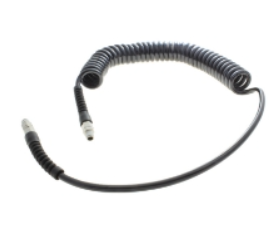

Air tools have a distinct operational advantage over electric machines in professional shop environments: they do not overheat under sustained load, they provide consistent torque independent of battery charge level, and they are generally more compact for a given power output than an equivalent electric motor. For shops with compressed air infrastructure already in place, an air-driven polishing tool adds detail-area capability without adding electrical load or battery management complexity to the tool fleet.
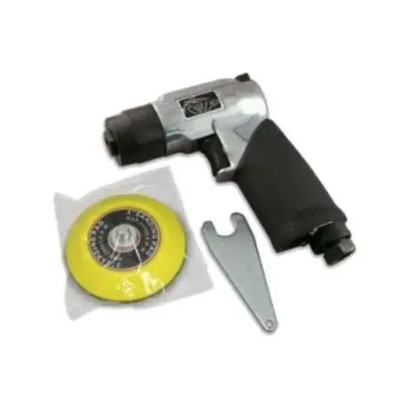
The Mini Air Tool TEC1602 is a compact pneumatic polishing and detail tool for professional shop use. Driven by compressed air from a standard shop compressor connection, the TEC1602 delivers consistent, variable-speed polishing operation for light compound, polish, and sealant application in areas where full-size air polishers or DA machines are too large to maneuver. The mini form factor makes it the tool for door jambs, tight body contours, wheel details, and any surface section where machine size is the limiting factor in professional machine polishing work.
What This Tool Is
This is a mini pneumatic (air-powered) polishing tool. Compressed air drives the motor — there are no batteries to charge and no electric motor to overheat under extended use. The compact body allows operation in areas that exclude full-size polishers. It accepts small polishing pads sized for the tool’s backing plate and operates across the speed range appropriate for light to medium polishing and product application tasks in detail work areas.
Key Features and Why They Matter
- Pneumatic (air-driven) operation — compressed air powers the motor with no battery management and no motor overheating under sustained use. Means consistent performance throughout a long session in a shop with air infrastructure.
- Mini compact form factor — reaches door jambs, mirror housings, wheel spoke details, and narrow body contours that full-size polishers cannot access. Means machine polishing in detail areas for more consistent, professional results than hand application alone.
- Compatible with standard shop air connections — connects to existing shop compressor lines. Means no additional infrastructure investment in a shop already using air tools.
- Variable speed control — adjustable air flow controls pad speed for different products and surface conditions. Means appropriate speed for light polish application on soft finishes and faster speed for compound work on harder surfaces.
- Professional tool durability — air tool construction for sustained professional shop use. Means long service life without the wear concerns of hobby-grade mini polishers.
What This Tool Is NOT For
The mini air tool is a detail and light-correction tool — not a replacement for a full-size orbital or rotary for broad panel paint correction. Do not attempt high-aggression compounding on large surfaces with this tool — pad size and torque characteristics are not suited for production panel correction. This tool requires compressed air — it cannot be used without an air compressor. Not for home use without appropriate air supply equipment. Do not operate below the recommended air pressure or above the rated maximum PSI.
Who Uses This
Professional detail shops with compressed air infrastructure in place, body shop detail departments with existing air tool systems, specialty detailers doing complete vehicle correction including jambs and detail areas, and shops that prefer air tool systems over battery-electric for their operational consistency and durability. The TEC1602 is the tool that allows a compressed-air-based shop to do complete machine polishing without switching to electric for the detail areas. Browse the air tools category for complementary air tool products.
How to Use
- Connect to air supply: Connect the tool to your shop air line at the appropriate PSI for this tool — check the tool’s rated operating pressure.
- Install backing plate and pad: Mount the appropriate size backing plate and select a pad matched to the product and task.
- Apply product: Apply a small amount of compound, polish, or sealant to the pad.
- Adjust speed: Set air flow to the appropriate speed — lower for product spreading and gentle finishing, higher for light compound work.
- Work the area: Move the tool continuously over the working area. Do not dwell in one spot.
- Wipe and inspect: Remove residue with a clean microfiber and inspect the result.
Why Buy Air vs. Battery Mini Polisher
Battery mini polishers are the right choice for shops without compressed air or mobile operators who need cord-free and hose-free portability. For shops with shop air already in use — compressor running daily for tire service, air tools, and spray equipment — an air mini polisher integrates directly into the existing infrastructure without adding another device to charge and manage. Air tools also tend to provide more consistent torque at a given RPM than battery tools at equivalent size, which matters for production consistency in professional use.
Frequently Asked Questions
What air pressure does this tool require?
Check the TEC1602 product specifications for the rated operating air pressure. Most mini pneumatic detail tools operate effectively between 60–90 PSI on a standard shop compressor. Do not exceed the tool’s rated maximum PSI.
What size pads does the TEC1602 use?
The pad size is determined by the backing plate included or purchased separately for the tool. Check the product specifications for the backing plate size and verify compatible pad options before ordering pads.
Does it come with a backing plate?
Check the product listing for included accessories. Some professional air tools are sold body-only; others include a backing plate. Confirm included components before purchase.
Can I use this tool for wax application?
Yes — a mini air tool with a soft foam pad is well suited for wax and sealant application in door jambs and detail areas where hand application produces uneven coverage. Run at a low speed setting for product application.
What CFM does my compressor need to run this tool?
Check the TEC1602 specifications for the rated CFM (cubic feet per minute) requirement. Mini air tools typically have modest CFM requirements that most standard shop compressors (1-3 HP) can sustain comfortably. Verify your compressor’s output CFM against the tool’s requirement before purchase.