
Heavy paint correction — the kind that follows a fresh 800 to 1200 grit wet sand, or that takes on heavily oxidized single-stage paint, or that needs to remove deep swirls from a vehicle that has not seen a proper correction in years — requires a compound that is genuinely aggressive at the start of the work cycle. A compound that cuts softly enough to be used confidently on thin modern clear coat but hard enough to produce visible correction in reasonable time is the professional balance most heavy-cut compounds fail to strike.
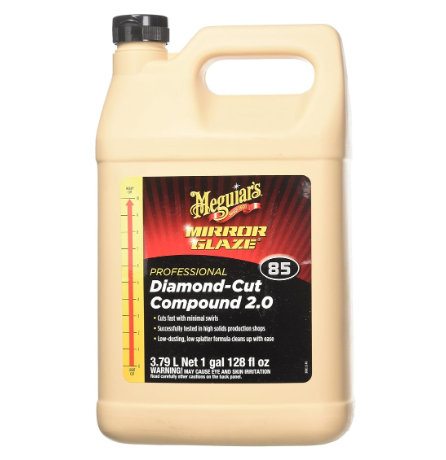
Meguiar’s Diamond Cut Compound 2.0 1 Gallon is the Meguiar’s flagship heavy-cut compound built for the most demanding paint correction applications. Body shops, full-correction detailers, and restoration specialists trust Diamond Cut for the difficult work that requires real abrasive performance from a production compound. The 1-gallon supply size makes that performance available at production volume economics.
What Diamond Cut Compound Is
Meguiar’s Diamond Cut Compound 2.0 is a heavy-cut machine compound using Meguiar’s Super Micro Abrasive Technology — abrasive particles engineered to cut aggressively during the work cycle and then diminish to a finer finish as working continues, reducing the number of post-compound polishing steps needed to achieve a finished surface. It is rated for removing 800-grit and finer sanding marks on rotary polishers and works on DA polishers with cutting pads for less aggressive applications.
Key Features and Why They Matter
- Super Micro Abrasive Technology — Meguiar’s proprietary diminishing abrasive system. So what? The compound cuts hard at the start of the work cycle to remove defects, then the abrasives break down to finer particles as you work, leaving a finish that requires fewer subsequent polish steps than traditional heavy-cut compounds.
- 800-grit sanding mark removal — one of the most demanding correction benchmarks. Removes what most medium-cut compounds cannot, while finishing finer than what most heavy-cut compounds leave behind.
- Rotary and DA polisher compatible — works on direct-drive rotary polishers at 1200–1800 RPM for maximum cut and on DA polishers with cutting pads for controlled heavy correction.
- 1-gallon production supply — the volume that makes heavy correction work economically viable for shops doing multiple compound jobs per week. Per-job compound cost at gallon pricing supports profitable correction service rates.
What This Is NOT For
Diamond Cut Compound is the most aggressive Meguiar’s compound — it is not appropriate for light swirl removal on modern thin clear coats where a medium compound is the correct starting point. On very thin or soft clear coats, the aggression of this compound requires careful technique to avoid burning through. It is not a one-step compound — after Diamond Cut correction, the surface requires polishing with a medium polish and finishing with a fine polish or wax to reach the final gloss level. For the finishing steps, see Meguiar’s finishing products.
Who Uses Diamond Cut Compound 1 Gallon
Professional body shops doing paint correction after wet sanding at 800 grit or finer. Full-correction detailers who specialize in restoration-level paint correction on heavily oxidized single-stage paint, marine gel coat, and aged vehicles. Production correction shops that need the most capable compound in the Meguiar’s lineup and the supply volume to run it at operational scale. This is not a beginner compound — it requires experience with rotary and DA polisher technique to use correctly without causing paint damage.
How to Use
- Pad selection: On a rotary, use a cutting pad (orange or green foam cutting pad). On a DA, use an aggressive foam or microfiber cutting disc. Never use Diamond Cut on a finishing pad.
- Apply compound: 5–6 pea-sized dots on the pad face. Spread at lowest speed before working at speed.
- Rotary speed: 1200–1800 RPM. Work methodically with overlapping passes, 2×2 sections.
- DA speed: 5–6 (900–1200 OPM). Slower than rotary but with more passes per section.
- Work until compound breaks down: The compound changes consistency as abrasives diminish — this is the signal to inspect and move to the next section.
- Inspect and follow with polish: After correction, a medium polish pass (Meguiar’s 105 or equivalent) and finishing step are required before applying wax or coating.
Frequently Asked Questions
Can Diamond Cut Compound be used by hand?
Diamond Cut is formulated for machine application on a rotary or DA polisher. Hand application will produce minimal correction — the compound chemistry and abrasive particle system require machine speed to function correctly. For hand-application correction, use a less aggressive compound formulated for hand use.
What is the difference between Diamond Cut Compound and a standard heavy-cut compound?
The key difference is Meguiar’s Super Micro Abrasive Technology — the particles start aggressive and diminish to a finer state as you work the compound. A traditional heavy-cut compound maintains consistent abrasive aggressiveness throughout the work cycle and leaves a coarser finish that requires more follow-up polish steps. Diamond Cut compresses the correction-to-finish sequence.
How much compound is needed per panel on a heavily oxidized surface?
Heavy oxidation correction requires more product and more passes than defect-removal on maintained paint. For a severely oxidized hood, expect 3–5 passes with replenishment of compound between passes. Product usage rate for heavy correction is approximately 4–8 oz per full panel set on a mid-size sedan.
Is it safe on gel coat surfaces?
Yes — Diamond Cut Compound is used on marine gel coat for oxidation removal and restoration. Apply with a rotary or DA polisher, following the same technique as automotive paint. Gel coat can typically handle more aggressive compound work than modern thin automotive clear coats.
What is the shelf life of an opened gallon?
Store sealed at room temperature, away from freezing. Opened gallon containers maintain full product performance for 18–24 months when stored correctly. Stir or shake before use if separation occurs after extended storage.