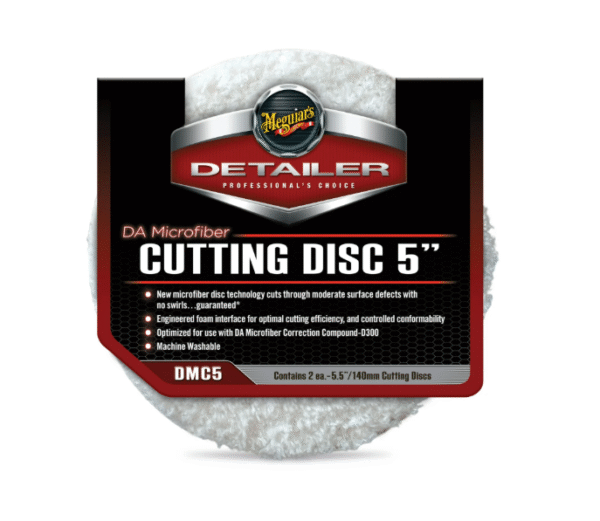
Paint correction on tight areas — door pillars, bumper facings, roof rail transitions, and compound-curved fenders — demands a smaller disc that can maneuver without losing control at the edges. The 5-inch microfiber cutting disc handles those areas the way a 6-inch disc cannot: tighter working radius, better access to body line transitions, and less risk of running the disc edge into trim or rubber. For shops doing full-vehicle correction that includes pillars and tight sections, the 5-inch cutting disc is an essential part of the kit.
The DA Microfiber Cutting Disc 5″ Bulk (12-Pack) puts a full case of 5-inch cutting discs in front of shops that run them regularly. The 12-pack is the right format for production operations where single-job disc consumption is steady and per-disc cost matters. Each disc delivers the same microfiber cutting performance as the 2-pack format — the difference is volume efficiency for shops that have already proven out the product.
What These Discs Are
These are 5-inch microfiber cutting discs with a textured microfiber face, hook-and-loop backing, and construction designed for DA random-orbit polisher use. The microfiber face cuts heavy defects faster than foam at DA machine speeds while managing heat better than aggressive foam cutting pads. The 5-inch size pairs with 5-inch high-flex backing plates for use on smaller panels and tight paint correction sections.
Key Features and Why They Matter
- 5-inch compact diameter — tighter working radius than 6-inch discs. So what? Better access to pillars, small panels, bumper sections, and curved transitions where a 6-inch disc cannot maneuver without edge risk.
- 12-pack bulk format — production-quantity supply at reduced cost per disc. For shops running cutting discs daily, the bulk case eliminates constant reordering and ensures fresh disc inventory is always available.
- Microfiber cutting face — faster defect removal than foam on DA machines. More aggressive delivery of compound to the paint surface means fewer passes per panel.
- Hook-and-loop backing — attaches to standard 5-inch DA backing plates in seconds. No tools required for pad changes.
- Fresh disc performance — buying in bulk means always having an unused disc available. Heavily used microfiber discs cut noticeably slower than fresh ones, so bulk inventory lets shops keep performance consistent.
What These Are NOT For
Microfiber cutting discs are for the cutting phase of paint correction only — not the finishing phase. Always follow cutting discs with a finishing disc or foam finishing pad to refine the surface before wax or coating application. Do not use on matte or satin finishes. Do not use on plastic trim, rubber, or textured surfaces. The 5-inch cutting disc is the working size for tight sections — for large flat panels, the 6-inch bulk cutting disc covers ground more efficiently.
Who Uses These
Production correction shops running full-vehicle paint correction where 5-inch and 6-inch cutting disc systems are used together, mobile correction detailers doing regular correction work who want fresh discs without constant small reorders, body shop operations doing light correction before coating application, and high-volume mobile detailers who run through discs fast enough that the 2-pack format is inefficient.
How to Use
- Prime new discs with 3–4 small drops of compound across the face before first use.
- Apply compound to the disc or the panel — use less than you would with foam. Microfiber holds product efficiently.
- Set DA speed at medium (speed 4–5 on most machines) for cutting. Moderate speed with light machine pressure allows the microfiber to work effectively.
- Work in overlapping passes across each section. The 5-inch size is well-suited for 6-12 inch working sections on tight panels.
- Brush the disc face with a pad conditioning brush between passes to release loaded compound.
- Inspect and rotate discs — pulling a fresh disc from the 12-pack when one becomes loaded maintains consistent performance across a long correction session.
Why Buy in Bulk vs. 2-Packs
For a shop running 5-inch microfiber cutting discs on every full-vehicle correction, the 2-pack is quickly exhausted. The 12-pack bulk format provides enough inventory for multiple weeks of work, reduces cost per disc compared to 2-pack pricing, and eliminates the disruption of running out of cutting discs mid-session. For shops that have already validated the 5-inch cutting disc in their correction workflow, the bulk case is the practical next step. Start with the 5-inch 2-pack if you have not used the product before.
Frequently Asked Questions
How many uses do I get from each microfiber cutting disc?
With proper care — rinsing after each session, drying flat, and cleaning the face during use with a pad brush — a single microfiber cutting disc typically lasts 5–15 correction sessions before performance degrades noticeably. Heavy correction work on severely defected paint uses discs faster than light correction. Buying in bulk ensures you always have fresh discs available when a used one reaches end of performance life.
Should I use the 5-inch or 6-inch cutting disc for full-vehicle correction?
Both. The 6-inch cutting disc works faster on large flat panels. The 5-inch cutting disc provides better access to pillars, bumpers, and tight sections. A professional full-vehicle correction typically uses both diameters — 6-inch for the majority of panel surface, 5-inch for edges and tight geometry.
What backing plate do I need for 5-inch microfiber cutting discs?
A 5-inch hook-and-loop DA backing plate with 5/16″x24 thread is the standard pairing. The 5″ DA Grip High-Flex Backing Plate is a compatible option that helps maintain even pad contact on curved panels.
Can these discs be washed in a washing machine?
No — machine washing microfiber cutting discs damages the hook-and-loop backing and can cause the microfiber face to mat. Rinse by hand under warm running water, work out compound residue manually, and allow to air dry flat. Avoid fabric softener at all times.
What compounds work best with 5-inch microfiber cutting discs?
Medium to heavy-cut compounds with thin to medium viscosity work well. Very thick body compounds designed for rotary use may not spread well on a 5-inch disc. Products labeled for DA and microfiber application are the most efficient pairing — they are formulated to work with the microfiber delivery mechanism rather than foam.