Pressure washer nozzle selection is not just about convenience — it determines whether you are safely rinsing paint or concentrating enough pressure to etch clear coat, damage rubber trim, and peel decals. A 0-degree pencil jet at 3000 PSI will strip paint from body filler and damage seals. The same machine with a 40-degree white nozzle disperses that pressure across a wide fan pattern that is safe for paint rinsing and pre-soak applications.
The 40-Degree White Quick-Connect Pressure Washer Nozzle — 3.5 Orifice from Polishing Systems Inc is the correct nozzle for the paint-safe exterior washing and rinsing work that professional detailing and fleet washing operations perform daily.
What This Nozzle Is
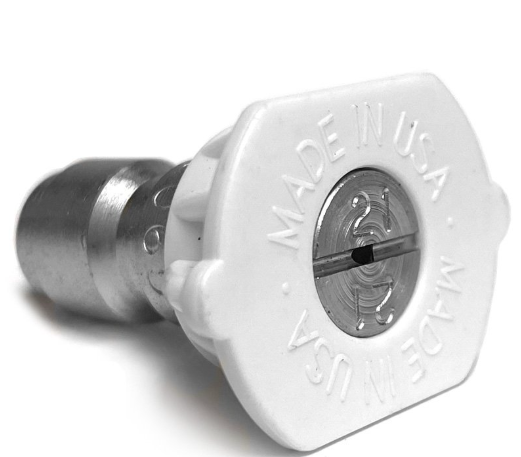
This is a 40-degree pressure washer spray nozzle with a 3.5-size orifice opening and a standard quick-connect fitting for tool-free attachment to pressure washer guns. The 40-degree angle produces a wide fan pattern — the widest in the standard nozzle angle range (0/15/25/40/65 degrees). White is the standard color code for 40-degree nozzles across major pressure washer brands. The 3.5 orifice is a medium-flow size appropriate for professional pressure washer units in the 2–4 GPM flow range.
Key Features and Why They Matter
- 40-degree spray angle — the widest, most dispersed standard nozzle angle. Spreads pressure across a larger contact area, reducing PSI concentration at any given point on the surface. Safe for vehicle rinsing, pre-soak application, and final rinse passes on automotive paint at appropriate stand-off distance.
- 3.5 orifice size — matched to professional-grade pressure washers in the 2–4 GPM flow range. The orifice size and machine GPM rating must be compatible for optimal machine performance — too small an orifice restricts flow; too large reduces downstream pressure.
- Quick-connect fitting — tool-free attachment and removal. Swap between nozzle angles during the wash workflow without tools. Standard QC fitting compatible with most professional pressure washer guns using the industry-standard quick-connect format.
- White color identification — the consistent cross-brand color code for 40-degree nozzles. Immediately identifies the correct rinse nozzle in a multi-nozzle workflow without reading labels.
- Stainless or hardened construction — nozzle tips are precision-machined to maintain orifice geometry under the erosion of high-pressure water flow. Quality nozzles maintain spray pattern accuracy across their service life.
What This Nozzle Is NOT For
The 40-degree white nozzle is the widest standard angle — not appropriate for power-washing contamination, stripping wheel brake dust, or any application where concentrated spray pressure is needed. For engine degreasing, wheel cleaning, and heavy contamination removal, a 15- or 25-degree nozzle at appropriate stand-off distance is more effective. Confirm orifice size compatibility with your specific pressure washer’s GPM rating — using an incorrect orifice size can affect machine performance and pressure. Do not use at zero stand-off distance on any painted surface regardless of nozzle angle.
Who Uses the 40-Degree White Nozzle
Professional detailers rinsing vehicles after foam pre-soak or soap application. Car wash operations doing final rinse passes on customer vehicles. Fleet washing operations doing pre-rinse and final rinse on commercial vehicles where paint damage from narrow nozzles is a service liability. Mobile detailers who need a paint-safe rinsing nozzle for their pressure washer kit. Any exterior wash operation where the rinsing step must be paint-safe.
How to Use the 40-Degree White Nozzle
- Connect the nozzle: Press the quick-connect fitting firmly onto the pressure washer gun until it clicks. Pull back on the collar to verify the nozzle is locked.
- Maintain safe stand-off distance: For painted surfaces, maintain at least 12–18 inches of stand-off distance from the nozzle to the paint surface. Closer distances increase effective PSI at the surface, even through a wide nozzle.
- Work top-to-bottom: Rinse from the roof down to prevent already-rinsed areas being re-contaminated by runoff from above.
- Use for pre-soak and final rinse: The wide fan pattern makes this nozzle efficient for applying foam pre-soak (with a foam cannon) and for final rinse to remove all soap from panels and crevices.
- Transition to narrower nozzles for contamination: For wheel cleaning, engine degreasing, and heavy soil removal, switch to a 15 or 25-degree nozzle at greater stand-off distance from paint.
Why Buy a Replacement vs. Using the Stock Nozzle
Stock nozzles that come with consumer pressure washers are often low-quality with poor orifice geometry that changes under use, producing inconsistent spray patterns. Professional replacement nozzles maintain precise orifice sizing for consistent pressure and pattern throughout their service life. At $9.39, replacing a worn or damaged nozzle is an economical maintenance decision. Browse our full exterior wash equipment and nozzle selection for the complete angle and orifice range.
Frequently Asked Questions
What orifice size is right for my pressure washer?
Orifice size selection depends on your machine’s rated PSI and GPM. General guidance: lower PSI and GPM machines (1500–2000 PSI, 1–2 GPM) use smaller orifice sizes (2.0–3.0); higher-output machines (2500–4000 PSI, 3–5 GPM) use larger orifice sizes (3.5–5.0). Using an orifice too small for your machine causes excessive back-pressure; too large reduces nozzle pressure. Contact our team or a pressure washer specialist for guidance on your specific machine.
Is the quick-connect format compatible with my pressure washer gun?
Most professional pressure washer guns use the standard 1/4-inch quick-connect fitting. Verify your gun’s QC fitting size before ordering. Some industrial and commercial guns use 3/8-inch QC — these are not interchangeable without an adapter.
How often should nozzles be replaced?
Nozzle orifice geometry erodes over time from high-pressure water flow, particularly with hard or mineral-heavy water. Replace when the spray pattern becomes uneven, the pressure drops noticeably at the same machine settings, or the nozzle tip shows visible wear. For professional washing operations using nozzles daily, annual replacement is common practice.
Can I use this nozzle to apply soap through a downstream chemical injector?
Yes — the 40-degree wide pattern is commonly used with downstream chemical injectors for soap or foam application. The wide fan distributes soap evenly over paint panels during the pre-soak step. For foam cannon use, the foam cannon replaces the nozzle entirely — the 40-degree nozzle is used for the rinse pass after foam application.
What is the difference between white (40-degree) and other nozzle colors?
Standard nozzle color codes: Red = 0-degree (concentrated stream for stripping), Yellow = 15-degree (power wash), Green = 25-degree (all-purpose), White = 40-degree (wide fan, rinse), Black = 65-degree (soap/low pressure). Each angle is appropriate for different tasks. For professional detailing, the green (25-degree) and white (40-degree) nozzles are the most commonly used for surface washing and rinsing.