Washing a boat with automotive car wash soap or household dish soap is not a neutral act — many of those products are formulated with alkaline chemistry that strips wax and sealant from the surface on contact. On a vehicle that gets waxed once or twice a year at best, that matters. On a boat that is exposed to saltwater, UV radiation, and biological growth, stripping the protective layer with every wash accelerates the oxidation cycle that leads to gel coat degradation.
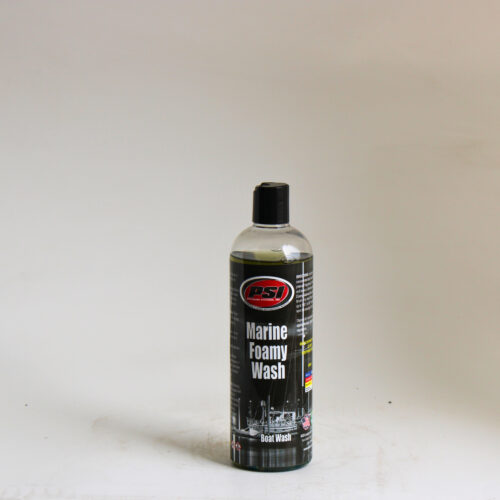
Marine Foamy Wash 1 Gallon is formulated specifically for the maintenance washing task on marine surfaces — it cleans the contamination without the alkalinity that strips protective coatings. The foamy consistency helps the product stay on vertical hull surfaces long enough to lift contamination rather than running straight off before it can work. For boat owners and marine detailers who wash regularly and want the protective investment to last, using the right soap matters as much as washing at all.
What Marine Foamy Wash Is
This is a pH-neutral, high-foam marine wash soap concentrate. It is formulated for regular maintenance washing of marine vessels — gelcoat, painted hull surfaces, fiberglass, and marine hardware. The neutral pH means it does not degrade wax or sealant on contact. The high-foam formulation provides lubrication for wash mitt work and a clinging action on vertical surfaces that standard low-viscosity soaps lack.
Key Features and Why They Matter
- pH-neutral formula — does not strip wax, marine sealant, or protective coatings during regular washing. Means your seasonal wax or coating investment survives through the wash season rather than being removed incrementally with each cleaning.
- High-foam formulation — clings to vertical hull sides long enough to lift contamination. On flat automotive panels, low-foam soap is adequate; on the curved, vertical surfaces of a hull, foam cling is a meaningful performance difference.
- Marine contamination compatible — the surfactant system is tuned for salt, biological matter, organic marine soils, and dock grime.
- 1-gallon concentrate — one gallon dilutes into many wash sessions. The per-wash cost of 1 gallon of concentrate is significantly lower than buying 16-ounce or 32-ounce single-use sizes repeatedly. Compare to the 16-ounce for smaller boats or trial use.
- Safe on gelcoat, painted surfaces, and hardware — broad surface compatibility for a complete vessel wash without product switching.
What This Is NOT For
Marine Foamy Wash is a maintenance wash soap — it is not formulated for heavy oxidation removal, antifouling treatment, or below-waterline hull cleaning. For heavy contamination or biological growth, see Marine Deck Wash. For mildew treatment on upholstery and canvas, see Marine Mildew Remover. Do not use as a pressure wash detergent at high concentrations — the formula is designed for wash mitt or soft brush application with appropriate dilution.
Who Uses This
Recreational boat owners who wash their vessel after each use rely on Marine Foamy Wash as their standard maintenance soap. The pH-neutral formula means they can wash the boat without worrying about stripping the annual wax or sealant treatment. Marine detailers performing full-service boat washes use it as the main wash step before hull polish and wax application. Freshwater boaters and saltwater boaters both benefit — freshwater boaters from removing organic growth, saltwater boaters from rinsing salt that accelerates every form of marine corrosion and gel coat degradation.
How to Use
- Dilute in a wash bucket — typically 1-2 oz per gallon of water for maintenance washing. Adjust concentration based on contamination level.
- Pre-rinse the hull with fresh water to remove loose debris and salt crust before washing.
- Apply with a wash mitt or soft marine brush. Work from the top down to prevent re-contaminating clean areas.
- Work in sections on the hull sides, rinsing each section before the soap dries.
- Rinse thoroughly with fresh water — particularly important in saltwater environments where rinsing removes salt before it can recrystallize.
- Dry with a chamois or microfiber for a spot-free finish.
Why Buy Marine Foamy Wash vs. Automotive Car Wash Soap
Automotive car wash soaps are formulated for automotive paint and clear coat — a different surface chemistry than marine gelcoat. Marine gelcoat is porous, thicker, and reacts differently to pH extremes. Marine Foamy Wash is specifically calibrated for marine surfaces, marine soils, and the salt-heavy environments boats live in. The foamy consistency also provides better cling on vertical hull surfaces than many automotive wash soaps designed for horizontal panel washing.
Frequently Asked Questions
How does the 1-gallon compare to the 16-ounce or quart sizes?
Same formula — just more of it. The 16-ounce and 32-ounce sizes are for small boats and trial use. The 1-gallon is the everyday working size for regular boat owners. High-volume operations should consider the 5-gallon.
Will this soap remove my wax or sealant?
No — the pH-neutral formula is specifically designed to clean without stripping protective coatings. It is the appropriate soap choice for waxed, sealed, or polymer-coated hull surfaces.
Is it safe for use in a foam cannon or foam gun?
Marine Foamy Wash can be used in foam-generating equipment at appropriate dilution. Test your specific equipment’s concentration settings — the formula produces significant foam even at low concentration, so start at the lower end of your foam cannon’s ratio range.
How long does 1 gallon last?
At typical maintenance wash dilution (1-2 oz per gallon of water), 1 gallon of concentrate supports 60-120 gallons of wash solution. For a boat using 5-10 gallons of wash water per session, that represents 6-24 wash sessions from a single 1-gallon purchase.
Is this safe for use in marina environments where runoff is regulated?
Marine Foamy Wash is formulated with marine use in mind. Check your marina’s specific policies on dockside washing and runoff — some marinas require wash water containment regardless of product biodegradability. Always follow local environmental regulations for on-water cleaning activities.