
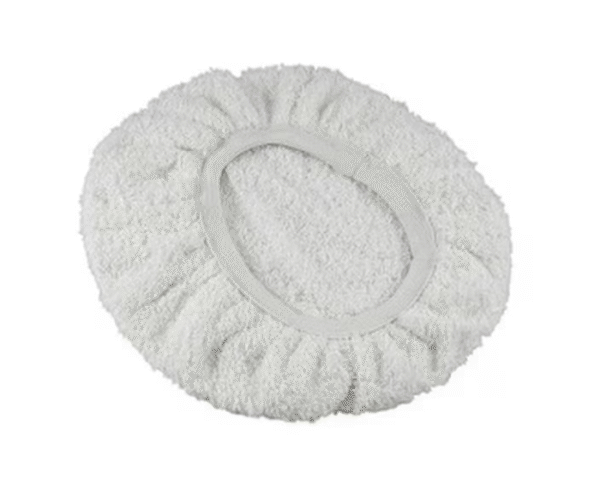
For large-surface wax application and product distribution, a terry bonnet on a rotary or DA polisher covers ground significantly faster than hand application or a standard foam applicator pad. The 9-inch format is particularly effective on large flat sections — van panels, RV siding, truck hoods, boat topsides — where the coverage area of the 9-inch bonnet multiplies throughput compared to smaller pad sizes. For shops running high-volume protective wax or detail spray as part of a production workflow, the terry bonnet format is a practical time-saver.
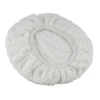
Terry Bonnet — 9 Inch from Polishing Systems Inc is the large-format machine polishing bonnet for production wax application, product distribution, and surface buffing on large vehicles and flat panel sections.
What This Bonnet Is
A 9-inch cotton terry loop bonnet that fits over a 9-inch foam applicator or polisher head. Used with a rotary or dual-action polisher for mechanical wax and product application across large surface areas. Machine washable for repeated professional use across many application sessions.
Key Features and Why They Matter
- 9-inch large format — covers significantly more surface per pass than smaller bonnets or standard pads. Meaningful throughput improvement on large flat vehicle surfaces.
- Cotton terry loop construction — holds and releases product evenly across the contact face. Distributes wax, protectant, and detail spray without product streaking or uneven application.
- Machine washable — rinse after use and machine wash without fabric softener for repeated use across many sessions. Lower per-application cost than disposable alternatives.
- Compatible with standard 9-inch polisher setups — pulls on over a standard foam backing pad or polisher head. No special mounting hardware required.
What This Bonnet Is NOT For
Terry bonnets are for wax application and product distribution — not for paint correction, compound work, or finishing polishing. For paint correction, use purpose-built foam correction pads. Do not use a terry bonnet with abrasive cutting compounds — the terry texture is appropriate for product application, not for abrasive surface work.
Who Uses This Bonnet
Detail shops and mobile detailers doing machine wax application on full-size trucks, vans, and RVs, fleet reconditioning operations applying protective wax to large vehicle fleets, marine detailers applying wax to boat topsides, and car wash operations offering machine wax application as a service tier.
How to Use
- Fit the terry bonnet over a 9-inch foam backing pad or polisher head.
- Apply wax or product to the bonnet face — do not over-saturate.
- Work at low speed (1,000-1,500 OPM or equivalent) for product distribution.
- Cover the panel in overlapping passes until product is evenly distributed.
- Remove the bonnet and switch to a clean microfiber for buff-off, or allow the wax to haze and buff off by hand or machine.
- Machine wash the bonnet after use to remove wax buildup.
For smaller-format options, see the Terry Bonnets 6-inch and the Terry Bonnet 6″ Heavy-Duty.
Frequently Asked Questions
Can I use the 9-inch bonnet on a standard 6-inch polisher?
The 9-inch bonnet is designed for a 9-inch backing pad or polisher head. It will not seat correctly on a 6-inch machine without the correct size backing pad. Match the bonnet size to the polisher pad size for proper fit and even product application.
Will the terry bonnet scratch delicate paint?
Terry loop construction is appropriate for wax application on most cured automotive paint finishes. For extremely delicate or freshly corrected paint where any surface contact carries risk, consider using a soft foam wax applicator pad instead. Always ensure the bonnet is clean and free of grit before applying to any painted surface.
How do I wash the bonnet after a wax application session?
Machine wash without fabric softener in warm water. Fabric softener coats terry fibers and reduces product absorption on future applications. Rinse thoroughly and allow to air dry or tumble dry on low. Inspect for embedded grit before reuse on painted surfaces.